
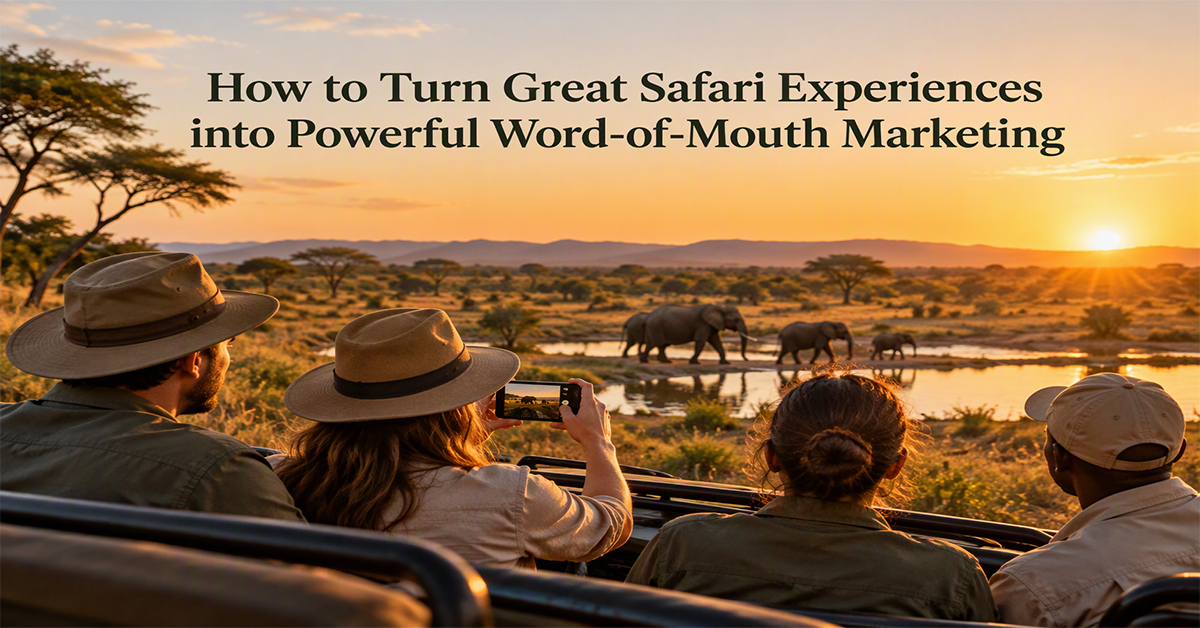
How to Turn Great Safari Experiences into Powerful Word-of-Mouth Marketing
A safari can be one of those rare travel experiences that people keep talking about years after they return home. A lion appearing beside a game-drive vehicle at sunrise, a guide explaining animal behaviour in a way that suddenly makes the landscape feel alive, or a quiet evening around a campfire can become much more than a pleasant memory. These moments become stories. And stories are the raw material of word-of-mouth marketing.
For safari operators, that creates a remarkable opportunity. You do not have to turn every guest into a salesperson, and you certainly do not need to pressure travelers into posting reviews or referring friends. Instead, the goal is to create an experience so thoughtful, distinctive, and emotionally engaging that guests naturally want to tell someone about it. When that happens, marketing becomes an extension of hospitality rather than something added on afterward.
The strongest safari word-of-mouth strategies begin long before a guest uploads a photograph or writes a review. They begin with the booking conversation, continue through airport pickup, live inside every game drive and meal, and remain active after the traveler returns home. Every interaction can either strengthen the story guests eventually tell or make that story less memorable.
Below is a practical framework for turning outstanding safari experiences into a sustainable source of conversations, reviews, referrals, social content, and repeat business.
1. Why Safari Experiences Create Natural Word-of-Mouth
Safari travel has an unusual advantage over many other forms of tourism: it naturally creates stories that people want to share. A typical product can be difficult to describe emotionally. A traveler might say that a particular hotel had comfortable beds or that a restaurant served good food, but those details rarely become unforgettable stories. Safari is different because the experience combines uncertainty, nature, discovery, scenery, wildlife, culture, and human connection.
A guest does not simply consume a safari. They participate in it. Every morning begins with a little anticipation because nobody knows exactly what the day will bring. Even when an itinerary is carefully planned, wildlife does not follow a script. The unpredictability creates tension, while the guide’s knowledge gives the traveller a framework for understanding what they see. That combination makes the experience naturally conversational.
Think about how people describe a memorable safari. They rarely begin with, “The vehicle had four-wheel drive.” Instead, they say something like, “We were driving quietly through the grassland when our guide suddenly stopped the vehicle.” The story then unfolds. There was an animal, a sound, a dramatic landscape, an unexpected encounter, or perhaps a tiny detail that the traveler would have completely missed without an expert guide.
That is precisely where word-of-mouth marketing becomes powerful. The guest has already done much of the marketing work without thinking of it as marketing. They are retelling an experience that has emotional value.
The challenge for a safari business is therefore not simply to ask, “How can we get more referrals?” A better question is, “How can we consistently create experiences that guests naturally want to retell?“
That shift changes everything. Instead of treating word-of-mouth as a promotional campaign, the business treats it as the result of excellent product design, hospitality, storytelling, and relationship building.
People remember experiences differently from the way they remember specifications. A traveler may forget the exact model of vehicle used during a game drive, but they are far more likely to remember watching the sunrise over the savanna while hearing distant wildlife calls. The difference comes down to emotional significance.
A powerful safari experience gives guests several layers of memory at once. There is the visual layer: landscapes, wildlife, sunsets, mountains, rivers, forests, and open plains. There is the sensory layer: dust beneath their shoes, cool morning air, the smell of coffee at sunrise, the sounds of birds, or the warmth of an evening fire. Then there is the emotional layer: excitement, curiosity, surprise, peacefulness, awe, and connection.
When these layers overlap, the experience becomes easier to recall and describe.
Safari operators can intentionally strengthen this effect without manufacturing artificial experiences. Small choices matter. A guide who remembers that a guest is particularly interested in birds can point out species throughout the trip. A camp that serves coffee at a beautiful viewpoint creates a ritual around an already spectacular setting. A thoughtful birthday surprise can transform an ordinary evening into a personal story.
The key is relevance. Guests do not necessarily remember the most expensive part of an experience. They often remember the part that felt specifically meant for them.
This is why personalization can become an important word-of-mouth asset. When guests feel seen rather than processed, they have another dimension of the experience to talk about. “They knew I loved photography and positioned us perfectly for the morning light” is a much stronger story than “The Company provided a good safari.”
The emotional memory effect also explains why a disappointing small interaction can sometimes undermine an otherwise excellent trip. Word-of-mouth is based on the entire experience, not merely the wildlife sightings. A confusing transfer, poor communication, rushed meal, or indifferent response to a problem can become part of the story too.
The objective, then, is not perfection. It is to create an experience with enough positive emotional moments that guests leave feeling that their trip mattered.
Advertising tells people what a business wants them to know. Stories tell people what another person actually experienced. That distinction is particularly important in tourism because travelers cannot fully evaluate a safari before buying it.
A potential guest may look at photographs of landscapes and wildlife, read an itinerary, compare prices, and examine accommodation descriptions, but none of those things can completely answer the question: What will this actually feel like?
Past guests can help fill that gap.
A traveller saying, “Our guide was incredible because he could explain animal behavior without making it feel like a lecture,” provides a kind of information that a conventional advertisement struggles to reproduce. A guest explaining how the team handled an unexpected vehicle issue may reveal more about operational reliability than a polished paragraph promising excellent service.
This is why safari businesses should think carefully about the stories they make possible.
A story does not need to be dramatic to be useful. Sometimes the most persuasive stories are surprisingly ordinary. Perhaps a guide noticed that a guest was tired and adjusted the schedule. Perhaps a lodge prepared a favorite meal after learning about a dietary preference. Perhaps staff helped recover a lost pair of binoculars. These details demonstrate attentiveness.
There is another important advantage: stories give potential customers a mental picture of themselves. Someone reading about a guest quietly watching elephants at dawn can imagine being there. That imagination reduces the psychological distance between research and purchase.
For that reason, businesses should avoid relying exclusively on generic promotional language such as “unforgettable,” “luxurious,” “once-in-a-lifetime,” or “world-class.” Those phrases are common across travel marketing. A specific story is more distinctive.
Instead of saying, “We create unforgettable safari experiences,” show what happened during one. Let guests describe the moment in their own words. Let guides explain the unusual behavior they observed. Let photographs support the narrative.
The most effective word-of-mouth strategy is often simple: give people something worth talking about, then make it easy for them to tell the story.
2. Build a Safari Experience People Want to Talk About
Word-of-mouth begins with the product itself. No referral program can permanently compensate for an experience that feels ordinary, inconsistent, or poorly organized. Discounts might generate temporary activity, but sustainable recommendations generally come from genuine satisfaction and emotional connection.
That means safari operators should examine the entire guest journey rather than focusing only on game drives. What happens immediately after booking? How quickly does the company answer questions? Is pre-trip information useful? Does the airport transfer feel organized? Does the first welcome create confidence? Does the guide understand the guest’s expectations? Does the final farewell feel personal?
Every stage contributes to the narrative.
One useful approach is to map the journey as a series of memory opportunities. Some moments are naturally exciting, such as a wildlife encounter. Others are operational, such as check-in or transportation. The operational moments may not create excitement, but they can create reassurance. A smooth transfer tells the guest, “You are in good hands.” That feeling matters.
Then identify moments where the business can add personality without becoming intrusive. Perhaps guests receive a simple briefing about what to expect. Perhaps a guide learns their interests before the first drive. Perhaps the team prepares a small surprise based on information shared during booking.
The goal is not to make every minute spectacular. That would be exhausting and unrealistic. Instead, create a rhythm: reliable service, authentic interaction, moments of discovery, opportunities for quiet, and occasional surprises.
A great safari should also leave room for the destination itself to be the star. Over-designed experiences can feel artificial. Guests generally do not need a manufactured “Instagram moment” when the real environment already provides extraordinary material.
The best word-of-mouth often emerges when the business removes friction and then gets out of the way enough for the destination, guide, wildlife, and guest relationships to create the magic.
A shareable moment does not have to be staged. In fact, staged moments can sometimes weaken authenticity. The strongest approach is to design conditions in which naturally memorable experiences are more likely to happen.
Consider timing. A sunrise drive provides different emotional possibilities from a midday drive. A quiet picnic in a scenic location creates a different memory from eating quickly between activities. An evening conversation with a knowledgeable guide may become as memorable as an animal sighting because it gives the traveler a deeper understanding of the destination.
Consider also surprise. People talk about experiences that exceed expectations. This does not mean making unrealistic promises. It means noticing opportunities to add thoughtful value.
Suppose a couple mentions during booking that they are celebrating an anniversary. That information should not disappear into a database. The team can use it appropriately: perhaps a private sundowner, a personalized note, or a small celebration at dinner. The gesture does not need to be extravagant. Its power comes from relevance.
Photographic opportunities can also be handled thoughtfully. Guests naturally want photographs, but safari operators should avoid turning every moment into a production. Instead, guides can understand what kind of photography guests enjoy and help them anticipate opportunities while respecting wildlife and ethical viewing practices.
Another powerful shareable element is access to knowledge. Guests love discovering things they could not have noticed alone. A guide pointing out tracks in the soil, explaining animal behaviour, identifying a birdcall, or describing how a landscape changes seasonally can transform scenery into a story.
The question to ask is: What will this guest tell someone when they get home?
If the answer is only “We saw lots of animals,” there may be an opportunity to deepen the experience. If the answer becomes “Our guide showed us how to read the tracks and suddenly the whole landscape looked different,” you have created something richer.
That kind of transformation is naturally conversational.
Personalization works best when it feels human rather than algorithmic. Travelers do not want to feel as though every preference has been extracted from a form and converted into a sales tactic. They want to feel that someone paid attention.
Start with simple information. Why did the guest choose the safari? Is this their first visit to Africa? Are they interested in photography, wildlife behavior, birds, conservation, culture, food, landscapes, hiking, or relaxation? Are they traveling with children? Are they celebrating something?
That information can help staff make better decisions.
A bird enthusiast might appreciate a guide who slows down for unusual species. A first-time safari traveler may need more explanation about what happens during game drives. A professional photographer may care deeply about vehicle positioning and light. A family with young children may benefit from flexible timing and shorter activities.
None of these details require a complicated marketing system. They require communication between the people who interact with the guest.
Authenticity matters because personalization can backfire when it becomes excessive. If every interaction contains a reference to something the guest mentioned during booking, the experience can feel strangely calculated. The objective is not to demonstrate that the company remembers everything. It is to use relevant information when it genuinely improves the experience.
This is similar to a good host at a dinner party. A thoughtful host remembers that someone does not drink alcohol and quietly offers an alternative. They do not announce the fact every hour.
Safari businesses can adopt the same principle.
Personalization also creates a natural foundation for future word-of-mouth. When guests describe the experience, they may say, “They really understood what we wanted.” That sentence communicates something powerful to future customers: the operator does not simply sell standardized itineraries; it listens.
The best personalization is therefore almost invisible. Guests notice the benefit, not the machinery behind it.
Large experiences are obvious. Small details are often what make them personal.
A warm greeting by name can make a tired traveler feel welcome. Remembering a preferred drink can make dinner feel more comfortable. Offering a blanket during a cool morning drive demonstrates attentiveness. Explaining what will happen next reduces uncertainty.
None of these actions is likely to appear in a brochure, but they can become part of a guest’s memory.
This is why safari companies should look for micro-moments of hospitality. These are brief interactions that require little money but demonstrate care.
The trick is consistency. A business cannot depend on one exceptional employee to create all of these moments. The organization should establish a culture where employees are encouraged to notice guest needs and act appropriately.
Staff also need permission to solve small problems without creating unnecessary bureaucracy. If a guest has a minor issue that can be fixed immediately, making them wait for multiple approvals can turn a small problem into a negative story.
The same principle applies when something genuinely goes wrong. Mistakes happen. Vehicles experience problems. Weather changes plans. Wildlife does not appear on schedule. A meal may occasionally be delayed. What guests remember can depend heavily on how the team responds.
Clear communication, ownership, and practical solutions can prevent an operational problem from becoming the defining memory of the trip.
Small details also create opportunities for post-trip storytelling. Guests might remember a guide who sang a local song, a chef who explained a dish, a camp staff member who recognized them at breakfast, or a ranger who shared an unexpected conservation story.
These moments humanize the business.
In marketing terms, they create specificity. Instead of saying, “The service was excellent,” guests can tell a concrete story about something an employee did. Specific stories are easier to remember, easier to share, and easier for future travelers to trust.
3. Make the Guide Part of the Story
A safari becomes more memorable when guests feel involved rather than merely transported from one attraction to another. This is one reason guides have such an important role in word-of-mouth marketing.
The guide is often the human face of the entire safari company. They interpret the environment, answer questions, manage expectations, make decisions, and shape the emotional rhythm of the day. Two companies can operate in the same destination and offer similar itineraries, yet guests may remember them completely differently because of the guide.
That makes guide training an important marketing investment.
A guide should obviously understand wildlife and local conditions, but communication skills matter just as much. Knowing facts is not the same as telling a compelling story. A guide who can connect an observation to the guest’s curiosity creates engagement.
Imagine seeing a large herd of elephants. A guide could simply identify the species and provide a few facts. Or the guide could invite guests to watch the herd for several minutes, explain social relationships, point out behavior, and encourage everyone to notice how the animals communicate.
The second approach turns observation into participation.
Guests should also feel comfortable asking questions. Some travelers are experienced wildlife enthusiasts; others may not know the difference between common species. A good guide can adapt without making anyone feel embarrassed.
This creates another word-of-mouth advantage: guests remember how they felt around the people serving them.
A guide who is patient, enthusiastic, observant, and respectful can become part of the story guests tell at home. In many cases, the guide’s name is remembered long after specific details of the itinerary have faded.
That is powerful brand building because it gives the company a human identity.
Storytelling should not mean turning every game drive into a lecture. The best guide-led storytelling is responsive to what is happening in front of the guests.
Start with observation. What are the guests looking at? What are they asking about? What have they already seen? Then build the explanation around that context.
A guide might explain an animal’s behavior, then connect it to the broader ecosystem. A plant can become the beginning of a conversation about rainfall. Animal tracks can open a discussion about movement patterns. A landscape can lead into the history and communities connected to that place.
This creates layers of meaning.
A traveler who sees an animal without context has one memory: “We saw a leopard.” A traveler who learns how the animal uses its environment, why it behaves in a particular way, and what clues helped the guide locate it has a much richer story.
Guides can also use questions. “What do you notice about the herd?” or “Why do you think those animals are standing there?” encourages guests to participate. When travelers make observations themselves, they become emotionally invested in the discovery.
Another important element is honesty. Wildlife encounters are unpredictable. Guides should not create false certainty just to satisfy expectations. If an animal disappears into tall grass, that is part of the experience. Explaining the uncertainty can actually make the encounter more exciting.
Great storytelling also respects local knowledge and culture. A safari should not reduce a destination to wildlife alone. Where appropriate and with proper context, guests can learn about landscapes, conservation, communities, history, food, and the people who make the region what it is.
That broader understanding gives travelers more to discuss after they return home.
Ultimately, guide-led storytelling transforms a safari from sightseeing into learning, discovery, and participation.
4. Turn Memorable Moments into Authentic Shareable Stories
Creating an excellent experience is only the first half of the process. The next challenge is helping guests preserve and communicate their memories without making the experience feel like a marketing campaign.
This is where user-generated content becomes valuable.
Guests already take photographs and videos during safaris. They already talk to friends and family. They already use messaging apps and social platforms to share travel experiences. A safari company can support that behavior by making it easy, while still allowing guests to remain in control of what they share.
The simplest strategy is to give people useful material. High-quality photographs, thoughtful captions, destination information, and interesting wildlife facts can help guests tell better stories.
But businesses should avoid assuming that every guest wants to become a content creator. Some travelers want to put their phone away and enjoy the landscape. Respecting that choice is part of a good experience.
A gentle invitation works better than pressure.
After an especially memorable experience, staff might mention that guests are welcome to tag the company if they share photographs. That creates an opportunity without turning hospitality into a request for free advertising.
Businesses can also make sharing easier through practical resources. A digital post-trip gallery, a downloadable itinerary, conservation information, or a personalized thank-you message can keep the relationship active.
The objective is not simply to collect more photographs. It is to encourage richer storytelling.
A photograph of a lion is visually appealing. A photograph accompanied by the story of how the guide tracked the animal, waited patiently, and explained its behavior is much more valuable from a word-of-mouth perspective.
That story contains context, expertise, emotion, and human connection.
Authenticity should be the guiding principle when encouraging user-generated content. People can usually distinguish between a genuine recommendation and a promotional script.
Start by creating moments guests naturally want to photograph. Scenic viewpoints, beautiful meals, wildlife encounters, cultural experiences, and distinctive camp details all provide organic opportunities.
Then make the process easy. If guests want to share, they should be able to find the company’s social handle without searching extensively. Consistent branding across the website, booking information, and post-trip communication helps.
But the company should not dictate what guests say.
Instead of asking travelers to use a predetermined phrase such as “best safari ever,” invite them to share their favorite moment. That simple change encourages genuine stories.
For reviews, the same principle applies. Rather than requesting only a five-star review, ask guests to describe what they enjoyed, what surprised them, or what they think future travelers should know. This produces more useful feedback and avoids making the interaction feel transactional.
Authentic reviews can also contain details that improve future marketing. A guest may mention that they loved the flexibility of the itinerary, the guide’s bird knowledge, or the way staff accommodated a dietary requirement. Those observations can reveal the aspects of the experience that customers value most.
Businesses can then use those insights in their own communications, provided they do so honestly and with appropriate permission.
User-generated content is particularly powerful because it shows the experience from the customer’s perspective. The operator’s website can explain what a safari is like, but a guest’s photograph and story demonstrate what it felt like to be there.
The goal is not to manufacture enthusiasm. It is to make genuine enthusiasm easier to express.
A conversation trigger is something specific that gives guests a reason to tell someone else about their trip.
Safari businesses can create these naturally through distinctive details. Perhaps guests learn a fascinating wildlife fact that they can repeat at dinner. Perhaps they receive a small locally meaningful keepsake. Perhaps a guide teaches them how to identify animal tracks. Perhaps the itinerary includes a particularly thoughtful conservation experience.
The trigger should have a story attached to it.
This is where creativity matters more than budget. A memorable experience does not necessarily require an expensive gift. Sometimes the most effective trigger is information.
For example, imagine a guide teaching guests how to distinguish several animal tracks. The guests may later show photographs to friends and explain, “Our guide taught us how to tell what had passed through the area.” The experience has now traveled beyond the safari.
Another trigger can be a meaningful ritual. A morning coffee overlooking the landscape, a sunset storytelling session, or a farewell tradition can become associated with the company.
Consistency can make these rituals part of the brand identity.
However, businesses should avoid turning every experience into a branded spectacle. The destination should remain authentic. A subtle, locally appropriate ritual is generally more memorable than an aggressively branded photo opportunity.
Conversation triggers also work after the trip. A personalized message asking, “What was the moment you still find yourself talking about?” can prompt guests to reflect on their experience. Their answer may become a review, a social post, or simply a conversation with a friend.
The key is to stimulate memory rather than demand promotion.
When guests revisit the emotional highlights of their safari, they are naturally more likely to talk about them.
5. Extend Word-of-Mouth After Guests Return Home
The safari should not end from a marketing perspective when the guest leaves the destination. The post-trip period is when memories are fresh, photographs are being organized, and friends and relatives are asking questions.
This creates a valuable window for relationship building.
The first post-trip communication should be personal and useful. A simple thank-you message can acknowledge the guest’s visit and reference something specific about their experience. If they mentioned loving elephants, photography, or a particular region, that detail can make the message feel genuine.
A company can also provide practical resources. Perhaps guests receive a digital collection of photographs, a conservation story, or a guide to identifying wildlife they saw. These materials extend the value of the trip without turning every communication into a sales pitch.
Timing matters. Sending a referral request immediately after the guest returns can feel transactional. Allowing a little time for the experience to settle may produce a more natural response.
Later, the company can invite guests to share their favorite memory or review the experience.
This creates a sequence:
Experience → reflection → storytelling → recommendation.
That sequence is more natural than:
Experience → sales request.
Businesses should also recognize that different guests prefer different communication channels. Some may respond to email. Others may engage on social media. Some may prefer occasional newsletters containing destination stories rather than promotional offers.
The objective is to remain useful.
A strong post-trip relationship also creates repeat business opportunities. Someone who enjoyed a safari may eventually return with a partner, children, friends, or colleagues. They may not need another trip immediately, but the brand can remain familiar without becoming intrusive.
Word-of-mouth compounds over time because one satisfied traveler can introduce several new people to the business.
The post-trip phase therefore deserves the same thoughtfulness as the safari itself.
A good follow-up message should remind guests that they were more than a booking number.
Instead of sending a generic “Thank you for choosing us” email, mention something real. Perhaps the guest’s guide remembers their enthusiasm for birds. Perhaps they celebrated an anniversary. Perhaps they were particularly interested in conservation.
The message should not feel as though a database automatically inserted their name into a template.
A short personal note from a guide can be especially powerful. Imagine receiving a message from the person who spent several days with you saying, “I hope you made it home safely. I still remember how excited everyone was when we found that leopard near the river.”
That message reactivates the memory.
Businesses can also ask a meaningful question. “What was your favorite moment?” is simple but effective. It encourages reflection and gives the guest an opportunity to tell their story.
If the guest responds positively, that conversation can naturally lead to a review or referral later. There is no need to rush.
Follow-up can also include educational content. Seasonal wildlife information, conservation updates, new photography from the destination, or stories from guides can help former guests remain connected.
This approach turns the customer relationship into a community rather than a transaction.
That distinction matters because word-of-mouth depends on emotional connection. People are more likely to recommend a company they still feel connected to than one that disappeared immediately after payment.
A thoughtful follow-up strategy can therefore produce value in several directions: reviews, referrals, repeat visits, social engagement, and stronger brand recognition.
The important thing is restraint. Too many messages can destroy goodwill. Every communication should earn its place by being useful, personal, or genuinely interesting.
If the company would not want to receive the message as a traveler, it probably should not send it.
6. Build a Referral-Friendly Guest Journey
A referral program can support word-of-mouth, but it should not be the foundation of it.
If a guest genuinely loves the safari, they may recommend it without receiving anything. A referral incentive can simply make that action easier or more rewarding.
The guest journey should therefore contain natural moments where referrals make sense.
For example, after a guest posts a positive review, the company could thank them and mention that friends or family can contact the business if they are planning a safari. The invitation is clear but not aggressive.
Referral systems also need to be easy to understand. Complicated conditions, unclear rewards, or difficult redemption processes create friction.
Businesses can choose incentives that align with their brand. These might include an upgrade, experience enhancement, credit toward a future trip, or a thoughtful benefit for both the existing and new customer.
However, the incentive should never encourage misleading recommendations. Guests should feel free to describe their actual experience honestly.
Referral tracking can also reveal useful patterns. Which destinations generate the most referrals? Which guides receive the most mentions? Which types of guests refer friends? Which experiences appear repeatedly in recommendations?
Those patterns can help businesses improve operations.
It is also useful to recognize that referrals do not always happen through formal referral links. A guest might send a company website to a friend, mention the operator in a private group chat, recommend it in a travel community, or tell a colleague over dinner.
Therefore, businesses should not judge word-of-mouth only by trackable referral codes.
The wider objective is recommendation behavior.
When the guest journey is easy, memorable, personal, and trustworthy, referrals become a natural extension of satisfaction. The referral program simply gives that behavior a little structure.
7. Measure, Learn, and Improve Word-of-Mouth
What gets measured can be improved, but word-of-mouth is not as simple to measure as advertising clicks.
Some recommendations happen privately. A traveler may tell three friends about a safari without ever mentioning the company’s name online. Another guest may publish a detailed review that generates future bookings months later.
The solution is to track multiple signals rather than searching for one perfect metric.
Start with direct referrals. Ask new customers how they heard about the business. Include options such as friend or family recommendation, online search, social media, travel advisor, previous visit, or other sources.
Then monitor review activity. Look for recurring themes rather than focusing exclusively on star ratings. Are guests consistently mentioning guides? Are they talking about flexibility? Do they praise communication? Are there repeated complaints about transfers?
Social mentions provide another layer. Track tags, mentions, user-generated posts, and comments where possible.
Website analytics can help connect the dots, but attribution will never be perfect. A traveler might hear about the company from a friend, search the brand several weeks later, read reviews, and finally book through the website. The final click does not represent the entire customer journey.
That is why qualitative feedback matters.
The words guests use can be more valuable than a single numerical metric. If multiple travelers independently describe the same aspect of the experience, the business has learned something about its real differentiators.
Word-of-mouth measurement should therefore answer three questions:
Are people recommending us?
What exactly are they recommending?
Which parts of the experience create those recommendations?
The answers can influence marketing, training, itinerary design, and operations.
The strongest companies treat word-of-mouth data not merely as a marketing report, but as a feedback loop for the entire guest experience.
A practical tracking system does not need to be complicated.
At the booking stage, ask every new traveler how they discovered the company. Record the answer consistently. If someone says, “My sister traveled with you,” that information is more useful than simply recording “online.”
Review monitoring should also look for language patterns. Imagine that guests repeatedly write about how guides adapt game drives around their interests. That could indicate a genuine competitive strength worth highlighting in marketing.
Similarly, if guests repeatedly mention confusion about pickup arrangements, the business has found an operational problem that could undermine future word-of-mouth.
Social mentions should be reviewed for context. A photograph might receive many likes while the accompanying caption contains a highly detailed recommendation. Another post might have a smaller audience but generate direct questions from potential travelers.
Reach is not the same as influence.
Businesses can also ask former guests a simple question periodically: “Would you recommend us to someone planning a safari?” The answer becomes more useful when followed by an open-ended question about why.
The “why” is where the insight lives.
Perhaps guests recommend the company because of the guides. Perhaps they appreciate honest communication. Perhaps they value small groups. Perhaps the company made traveling with children easy.
Those insights should feed back into positioning and service design.
One caution is important: do not reduce word-of-mouth to a vanity metric. A large number of social impressions does not automatically mean a large number of qualified travelers. The business should connect awareness signals with meaningful outcomes such as inquiries, bookings, referrals, repeat visits, and guest satisfaction.
The goal is not to make the biggest noise.
The goal is to understand which experiences make people willing to put their reputation behind a recommendation.
Feedback becomes valuable when it changes something.
If guests repeatedly say they loved learning about local ecology, the business might expand educational storytelling. If families say the itinerary felt too rigid, the operator could explore more flexible scheduling. If photographers repeatedly request better positioning during certain drives, guides could receive additional training.
This creates a virtuous cycle.
Better experience → better stories → stronger word-of-mouth → more guests → more feedback → better experience.
The cycle works only if feedback is taken seriously.
Businesses should distinguish between individual preferences and recurring patterns. One guest may dislike an activity that another guest considers the highlight of the trip. The objective is not to satisfy every preference equally. It is to understand which issues affect a meaningful portion of the guest base and which represent opportunities for personalization.
Negative feedback deserves particular attention. A complaint does not automatically mean the entire experience failed. Sometimes it reveals a mismatch between expectations and reality.
That mismatch can often be addressed before the trip through better communication.
For example, if travelers arrive expecting guaranteed wildlife sightings, the operator can explain before arrival that wildlife is unpredictable and that guides focus on responsible observation. Clear expectations make the actual experience easier to appreciate.
Feedback can also reveal the language guests naturally use to describe the company. Those phrases can become valuable SEO and marketing insights because they reflect real customer vocabulary rather than internal corporate terminology.
If guests repeatedly describe a safari as “flexible,” “personal,” “quiet,” “educational,” or “great for first-time travelers,” those concepts may deserve greater visibility in website copy.
The customer’s language can become the company’s marketing language.
That is one of the simplest ways to make tourism marketing feel more human: listen to how real people describe what they experienced, then communicate those qualities honestly.
8. Common Mistakes That Weaken Safari Word-of-Mouth
One of the biggest mistakes safari businesses make is assuming that spectacular wildlife automatically guarantees strong word-of-mouth.
It helps, certainly, but it is not enough.
A traveler might see an extraordinary animal and still leave frustrated because communication was poor, transfers were disorganized, or staff were disengaged. The wildlife encounter belongs to the destination; the way the company manages the experience belongs to the company.
Another mistake is overpromising.
Marketing language that guarantees specific wildlife sightings or presents every safari as flawless can create unrealistic expectations. When reality inevitably behaves like reality, the gap between promise and experience can damage trust.
Authenticity is especially important in safari marketing. The destination has enough genuine beauty that operators rarely need to exaggerate it.
A third mistake is aggressively requesting reviews. Asking guests repeatedly to leave five-star reviews can make a sincere relationship feel transactional. A better approach is to invite honest feedback and give guests an easy opportunity to share their experience.
Businesses can also make the mistake of ignoring employees. If guides, drivers, hosts, chefs, and other staff members are central to the guest experience, they are central to word-of-mouth marketing too.
Training should therefore include communication, hospitality, problem-solving, and storytelling—not just technical skills.
Another common problem is treating social media as the destination rather than the distribution channel. A safari should not be redesigned solely to produce photographs. The real experience comes first.
Finally, businesses sometimes focus too much on acquiring new customers and too little on former guests. Past travelers are already familiar with the brand. They have experienced the product. If the relationship is maintained thoughtfully, they can become some of the most credible sources of future business.
Word-of-mouth is not a trick.
It is the public expression of a private experience.
There is a fine line between enthusiasm and exaggeration.
Safari operators naturally want to communicate excitement. They want travelers to understand the beauty of the destination and feel inspired to visit. But when every photograph is described as “once in a lifetime,” every guide is “the best,” and every itinerary is “unforgettable,” the language starts to lose meaning.
Specificity is stronger.
Instead of promising an “unforgettable wildlife experience,” explain what makes the experience distinctive. Maybe the operator emphasizes small groups. Perhaps the guides specialize in natural history. Maybe the itinerary allows more time in particular habitats. Maybe the company focuses on responsible tourism and meaningful local engagement.
Specific claims give travelers something they can evaluate.
The same principle applies to reviews. Do not manufacture testimonials or encourage guests to repeat marketing language. Genuine reviews are valuable precisely because they sound like customers.
Businesses should also resist the temptation to hide every imperfection. Responsible communication about weather, wildlife unpredictability, travel conditions, and seasonal differences helps customers make informed decisions.
Ironically, honest expectations can make positive experiences feel better.
If guests understand that a safari is not a zoo and that wildlife sightings can never be guaranteed, an unexpected encounter can feel like a genuine discovery rather than a promised deliverable.
Over-selling can also affect employees. If marketing promises something impossible for guides to deliver consistently, staff are placed in a difficult position. They must manage the gap between customer expectations and reality.
Better marketing begins with a truthful product.
When the experience genuinely delivers, guests can tell the story without being coached. And that is the strongest form of marketing a safari business can receive.
Conclusion
The most powerful safari word-of-mouth marketing strategy does not begin with a referral code, a social media campaign, or a request for reviews. It begins with the experience itself.
A remarkable safari gives people something they want to remember. A thoughtful guide gives them context. Personalization makes the journey feel relevant. Small acts of hospitality make the experience human. Authentic storytelling gives guests language for what they experienced. And thoughtful follow-up keeps those memories alive after the traveler returns home.
The central idea is simple: do not try to manufacture word-of-mouth; create the conditions in which word-of-mouth happens naturally.
That means paying attention to the entire guest journey. Make booking communication clear. Make arrival reassuring. Train guides to observe, explain, and listen. Build memorable moments without staging artificial ones. Encourage guests to share their stories without pressuring them. Ask for honest feedback. Track referrals and recurring themes. Then use what you learn to improve the experience again.
A safari operator that follows this cycle is doing more than marketing. It is building a reputation one guest at a time.
And reputation is especially powerful in travel because people are not simply buying a product. They are trusting a company with time, money, expectations, and often a dream they have carried for years.
When the experience respects that trust, the guest has a reason to tell someone else.
That conversation may begin around a dinner table, in a family group chat, during an office conversation, in a travel community, or through a photograph shared online. The channel can change. The underlying mechanism remains the same: one person’s genuine experience becomes another person’s reason to pay attention.
That is the real power of safari word-of-mouth marketing.