

How to Turn Happy Travel Clients into Powerful Brand Ambassadors
A happy travel client can do something your most polished advertisement cannot: tell another person, in their own words, that your business is worth trusting. Think about it. When someone is planning a safari, honeymoon, family vacation, adventure tour, or once-in-a-lifetime cultural experience, they are not simply buying transportation and accommodation. They are buying confidence that the trip will actually live up to the dream in their head. That is why a genuine recommendation from a friend, relative, colleague, or fellow traveler can carry enormous weight. Your clients have already experienced what you promise, so their stories can become some of your strongest marketing assets.
The opportunity becomes even bigger when you deliberately turn customer satisfaction into brand advocacy. A brand ambassador is not necessarily a celebrity or paid influencer. In the travel industry, your most powerful ambassadors may be ordinary travelers who enthusiastically share photographs, post reviews, answer friends’ questions, recommend your company in travel groups, or send a relative your way when that person starts planning a trip. The key is not to pressure clients into promoting you. The goal is to create an experience so thoughtful, memorable, and trustworthy that talking about it feels natural.
That requires more than simply sending a review request after someone returns home. You need to understand the complete client journey, from the first inquiry to the final airport transfer and beyond. Every interaction creates another opportunity to earn trust. When you combine exceptional service, personal communication, memorable experiences, well-timed requests, social proof, and thoughtful follow-up, your customers can gradually become an extension of your marketing team. Better yet, they can do it in a way that feels human rather than promotional.
Why Happy Travel Clients Are Your Most Valuable Marketing Asset
Travel purchases are emotional decisions. A person may spend weeks comparing destinations, reading reviews, looking at photographs, asking friends for advice, and worrying about whether a particular company will deliver what it promises. This uncertainty gives personal recommendations tremendous practical value. A traveler who says, “I used this company and everything was handled beautifully,” is answering a question that an advertisement cannot answer as convincingly:
What was the experience actually like?
Your previous clients also possess something your business cannot manufacture on its own: lived experience. They know how quickly your team responded when plans changed. They remember whether the guide was knowledgeable and friendly. They experienced the quality of your accommodations, transfers, meals, excursions, and communication. They can describe the small details that never appear on a sales page. Those details make their stories believable because they come from experience rather than promotional language
There is another important advantage. Happy clients can introduce your business to audiences you may never reach through conventional marketing. One traveller might have friends interested in adventure tourism. Another could belong to a professional association, photography club, university community, church group, hiking club, or online travel community. Their recommendation can open a door that paid advertising might struggle to reach.
The smartest travel businesses therefore stop thinking of customer satisfaction as the final stage of a booking. It is actually the beginning of a potential advocacy relationship. Your goal is to create enough value that the client does not simply remember the destination. They remember who helped make the experience possible.
The Difference between a Satisfied Client and an Advocate
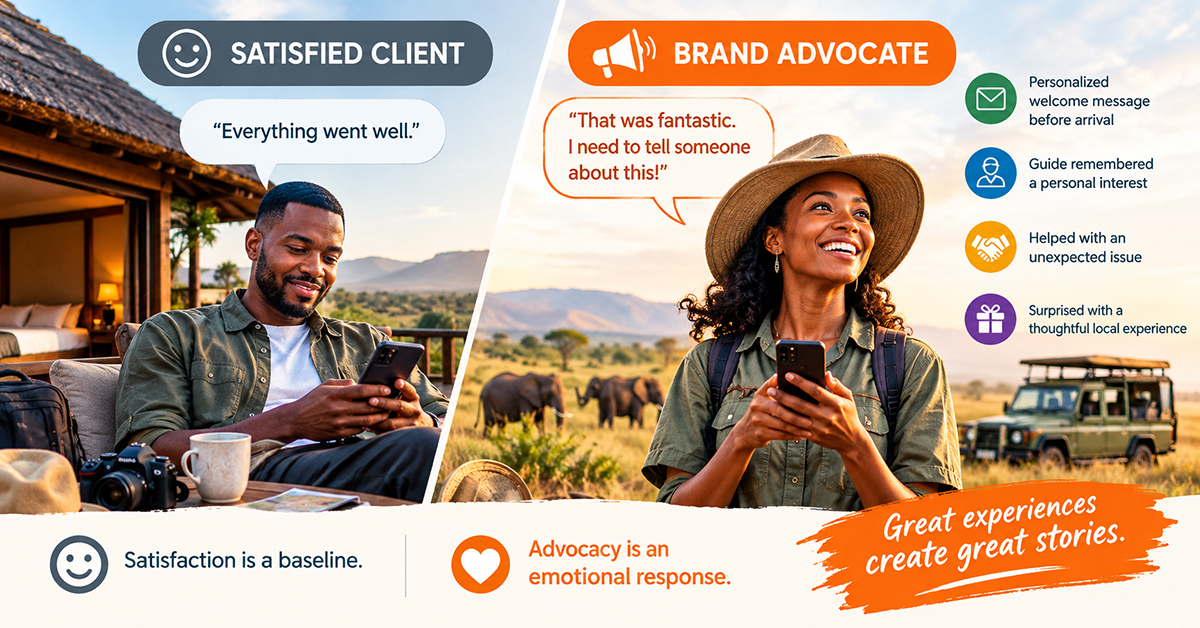
Not every satisfied customer becomes a brand ambassador, and that distinction matters. A satisfied client may think, “Everything went well.” An advocate thinks, “That was fantastic. I need to tell someone about this.” Satisfaction is a baseline; advocacy is an emotional response.
Imagine two travelers returning from the same destination. Traveler A enjoyed the trip, had comfortable accommodation, and experienced the activities listed in the itinerary. Traveller B received a welcome message before arrival, had a guide remember a personal interest, received help when an unexpected issue appeared, and was surprised with a thoughtful local experience that was never advertised as a major feature. Both travellers may be satisfied, but Traveller B has more stories to tell.
This is why brand ambassadorship cannot be created entirely through incentives. You can offer discounts for referrals, but you cannot manufacture genuine enthusiasm with a coupon. The strongest ambassador programs begin with an experience worth talking about.
Your task is to identify what transforms an ordinary successful trip into a story-worthy journey. Sometimes it is spectacular scenery. Sometimes it is a guide’s personality. Sometimes it is a staff member solving a problem before the client even notices it. Often, it is a combination of small details that makes the traveler feel recognized rather than processed.
Once you understand those moments, you can intentionally build more of them into your customer journey.
Why Authentic Travel Recommendations Build Trust
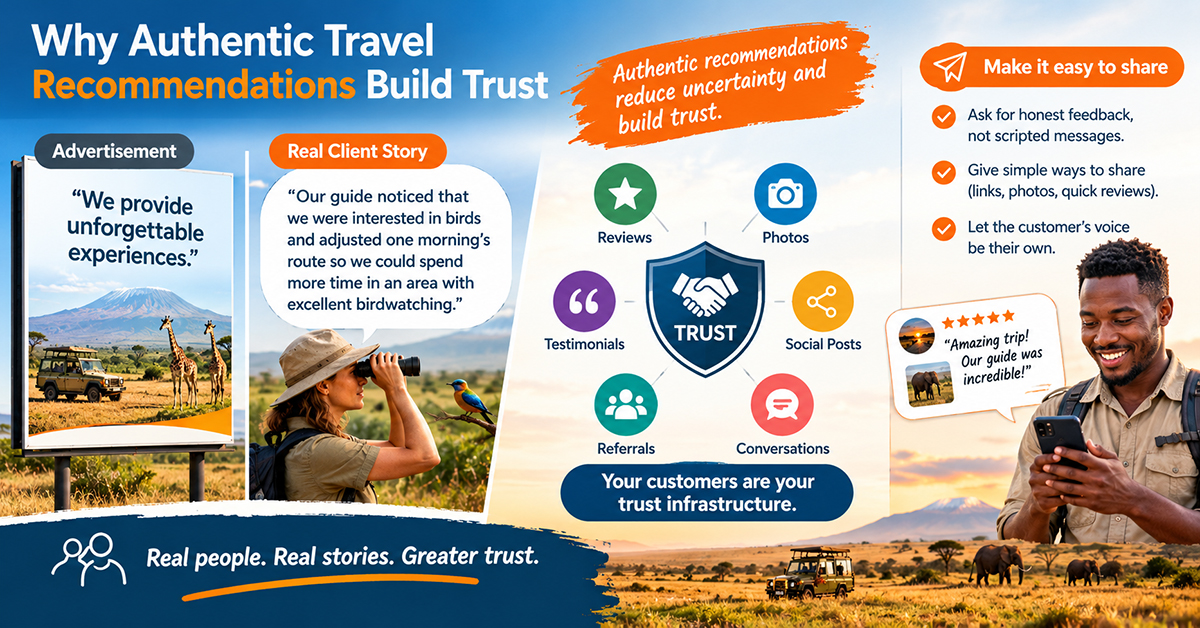
People naturally understand the difference between an advertisement and a personal story. An advertisement says, “We provide unforgettable experiences.” A former client might say, “Our guide noticed that we were interested in birds and adjusted one morning’s route so we could spend more time in an area with excellent birdwatching.” The second statement is specific, personal, and believable.
Authenticity matters because travel involves risk. Even when a customer has researched extensively, they may still wonder whether the reality will match the photographs. Recommendations from people they trust can reduce that uncertainty. Instead of relying exclusively on the company’s own promises, prospective customers receive evidence from someone who has already made the journey.
That makes your existing customers part of your trust infrastructure. Reviews, photographs, testimonials, social posts, referrals, and conversations all contribute to that infrastructure. They help future travelers visualize what doing business with you might actually feel like.
The important word is authenticity. Do not script every testimonial or tell clients what they should say. Give them an opportunity to describe their experience honestly. A short comment about a helpful guide can sometimes be more persuasive than a beautifully written paragraph filled with generic praise.
Your job is to make sharing easy while leaving the voice in the customer’s hands.
Create an Experience Clients Naturally Want to Share
Before asking clients for referrals, reviews, or social posts, look at the experience itself. Marketing cannot permanently compensate for weak service. You might generate a review request, but if the customer journey is confusing, slow, impersonal, or inconsistent, the request can actually remind customers of what went wrong.
The better approach is to design the journey with advocacy in mind from the beginning. Map every major interaction a traveler has with your company. What happens when they first discover you? How quickly do you answer an inquiry? What happens after payment? Do they know what to expect before departure? Is the arrival experience organized? Does the guide understand their interests? What happens if plans change? How do you follow up afterward?
Each stage can either build confidence or create friction.
You do not need to make every moment extravagant. In fact, many memorable experiences come from simple acts of attentiveness. A personalized welcome message, a useful packing tip, a birthday acknowledgment, a recommendation based on dietary preferences, or a quick check-in after a long travel day can make the customer feel that there is a real person behind the booking.
When clients feel cared for, they have something meaningful to talk about.
Design Memorable Moments Throughout the Journey
A memorable travel experience is rarely one giant event from beginning to end. It is usually a collection of moments. Some are expected, such as seeing wildlife on safari or watching a sunset from a beautiful viewpoint. Others are unexpected, such as discovering a hidden local restaurant, receiving help with a delayed bag, or having a guide explain a cultural tradition in a way that changes how the traveler sees the destination.
You can deliberately create these moments by identifying opportunities for positive surprise.
Start before the trip. Send something useful that demonstrates expertise rather than simply repeating booking information. A personalized destination guide, weather reminder, cultural etiquette note, or practical packing suggestion can immediately establish your company as a helpful partner.
During the trip, empower staff and guides to personalize the experience. If a traveler mentions photography, encourage the guide to notice good photo opportunities. If a family is traveling with children, identify activities that keep younger travelers engaged. If a couple is celebrating an anniversary, look for a tasteful way to acknowledge the occasion.
After the trip, continue the emotional momentum. Send photographs when appropriate, share a thank-you message, or remind the client of a memorable part of their journey.
These moments become conversation starters. A traveler may not tell someone about the invoice they received, but they may tell everyone about the guide who remembered their daughter’s name or the unexpected viewpoint that became the highlight of their trip.
Personalize the Experience Beyond the Itinerary
Personalization is often misunderstood as adding someone’s first name to an email. Real personalization goes much deeper. It means using what you learn about the traveler to make decisions and communication more relevant.
Suppose someone tells you they are passionate about wildlife photography. Instead of treating that information as a note buried in a customer relationship management system, use it. Ask what animals they particularly hope to photograph. Explain how the itinerary can support those interests. Share practical photography considerations. Make sure the guide knows.
Likewise, if a client is celebrating a milestone, traveling with elderly parents, bringing young children, or following specific dietary requirements, those details should influence how you serve them.
This is where travel businesses can compete through human attention rather than simply competing on price.
A personalized experience also gives customers a more interesting story to share. “They were really attentive to what we wanted” is powerful because it communicates both service quality and emotional care. It tells future customers that they will not simply be assigned an itinerary and forgotten.
The best personalization often feels almost invisible. The client simply notices that things seem to work unusually well for them. Behind the scenes, your team is using information responsibly to anticipate needs and remove friction.
That is exactly the kind of experience people remember.
Turn Small Service Details into Shareable Moments
You do not need a huge marketing budget to create shareable experiences. Small details can have disproportionate impact because they signal thoughtfulness.
For example, imagine a guest arriving after a long journey and discovering that the team has already arranged something that addresses a preference they mentioned weeks earlier. Or imagine a guide noticing that a client is uncomfortable and quietly adjusting the pace without making a fuss. These moments may never appear in your brochure, but they can become the stories clients tell.
Train your team to look for these opportunities.
Ask employees a simple question: “What could we do today that would make this traveler feel genuinely looked after?”
The answer might be practical rather than expensive. It could involve helping with luggage, explaining local customs, adjusting timing, finding a suitable meal, or providing reassurance during an unexpected delay.
There is a useful lesson here: customers often remember how your team made them feel more clearly than they remember every feature of the itinerary.
When a company consistently creates these emotional touchpoints, social sharing becomes a natural byproduct. A traveler takes a photograph, writes a caption, tells a friend, or mentions the experience in a review because the moment meant something.
That is much stronger than asking them to promote you simply because you need content.
Make Client Communication Part of the Experience
Communication can either strengthen the emotional connection created by a trip or quietly destroy it. A traveler may love the destination but become frustrated if emails go unanswered, instructions are unclear, or nobody explains what happens next. In contrast, clear and warm communication can make a complicated journey feel remarkably simple.
Think of your communication as part of the product. When someone books an international trip, they are not only buying accommodation, transportation, activities, and sightseeing. They are buying reassurance. They want to know that someone competent is paying attention.
That means every message should answer a practical question or create a useful emotional touchpoint. Avoid sending unnecessary messages merely because your system has an automated sequence. Automation can save time, but it should not make the relationship feel automated.
A good communication strategy balances consistency with personality. Templates are useful for ensuring important information is never forgotten, but employees should still have room to respond naturally when a customer asks a unique question.
Your clients should feel that they are communicating with a travel company that knows what it is doing, not fighting their way through a maze of generic emails.
Use Thoughtful Pre-Trip and Post-Trip Communication
The period before departure is often filled with excitement and anxiety. Travelers may wonder about weather, clothing, airport procedures, currency, connectivity, health considerations, luggage, meeting points, and countless other details. You can turn this uncertainty into an opportunity to demonstrate expertise.
Instead of waiting for customers to ask every question, proactively provide the information most relevant to their trip. A concise preparation guide can be incredibly valuable. So can a personal message from a trip coordinator explaining what will happen next.
The tone matters. “Please review the attached terms and conditions” feels administrative. “Your trip is getting close, so here are five things that will make your first day easier” feels helpful.
Stay Connected After the Trip
The same principle applies after the trip. Do not disappear the moment the traveler returns home. Give them time to recover, and then reconnect. Thank them for traveling with you. Ask about their favorite moment. Invite honest feedback. If they experienced an issue, give them a genuine opportunity to discuss it.
Post-trip communication can also reignite positive memories. When travelers receive a message asking about their favorite moment, they mentally revisit the experience. That emotional recall can make them more receptive to sharing photographs, writing a review, or recommending you to someone else.
Post-trip engagement does not have to be constant. In fact, excessive messaging can have the opposite effect. The objective is to remain relevant without becoming intrusive.
Start with gratitude. Thank the traveler for choosing your company. Ask how the experience went. Invite honest feedback. If there was a problem, acknowledge it and provide a channel for resolving it.
Then look for natural reasons to reconnect later.
Perhaps you can send inspiration for another destination that matches their interests. Maybe their family would enjoy a different type of trip. Perhaps you can contact them around the anniversary of their previous journey with a personal message.
This creates a transition from customer to community member.
Long-term relationships are especially valuable in travel because people often take multiple trips throughout their lives. A customer who booked one safari today could later need a honeymoon, family vacation, business trip, anniversary journey, group tour, or adventure experience.
If you remain memorable and trustworthy, you have a chance to be considered again.
Build Long-Term Relationships Instead of One-Time Transactions
A transaction-focused travel business asks, “How do we get this person to book?”
A relationship-focused travel business asks, “How do we become the company this person thinks of when travel comes up?”
Those are very different questions.
The second approach changes how you communicate. You stop sending messages only when you want money. You share useful destination information. You congratulate customers on milestones. You respond when they post about their travels. You remember preferences when they return.
This does not mean manually tracking every detail about every customer forever. It means using sensible customer relationship management practices to preserve relevant information and deliver genuinely useful communication.
You can also build community through newsletters, destination stories, traveler spotlights, events, or private groups where appropriate.
The goal is to create a sense that customers belong to something beyond a booking.
When travelers feel connected to your brand, advocacy becomes easier. They may recommend you even when nobody has asked. They may defend your reputation when another person asks for advice. They may tag your company in a photograph because they associate you with a positive chapter of their life.
That is the real power of brand ambassadorship.
You are not simply generating referrals. You are building a network of people who have personal reasons to trust and talk about your company.
Ask for Reviews and Referrals at the Right Time
Even delighted customers do not always leave reviews. They may intend to write one, become busy, forget, and move on with their lives. That does not necessarily mean they were unhappy. Often, the difference between receiving a review and receiving nothing is simply whether you made the process easy and asked at the right moment.
Timing is critical. If a traveler has just completed a particularly memorable activity, they may be emotionally engaged and excited to talk about the experience. If you wait several weeks, that enthusiasm may have faded. On the other hand, asking too aggressively while the customer is still dealing with travel arrangements or other logistics can feel inappropriate.
Look for moments when travelers naturally express satisfaction. Perhaps they say, “This has been amazing!” send a message praising the guide, share a positive photograph, or tell a staff member that everything has exceeded expectations. These are signals that they may be receptive to sharing their experience.
At that point, a simple request can work beautifully. Explain why their feedback matters, provide one clear destination for the review, and avoid overwhelming them with multiple forms or platforms.
The same principle applies to referrals. Instead of asking vaguely, “Do you know anyone who might need our services?” make the request more personal and specific: “If you have friends or family planning a trip like yours, we would be grateful if you shared our details with them.”
Identify the Client’s Peak Satisfaction Moment
Every travel business has moments when customers are particularly enthusiastic. Your job is to discover when these moments occur and use that understanding to improve the timing of your requests.
For a safari operator, it might be the morning after an exceptional wildlife sighting. For a honeymoon specialist, it could be the moment a couple experiences a carefully arranged romantic dinner. For an adventure company, it might happen immediately after clients complete an activity they were initially nervous about.
Track these moments through conversations, surveys, staff observations, and customer messages. Over time, patterns may emerge. You might discover that clients who praise their guides are especially likely to recommend your company, or that guests who receive personalized itineraries are more likely to leave detailed reviews. Perhaps customers become most enthusiastic immediately after returning from an excursion rather than at the end of the entire trip.
These insights can help you time your requests more intelligently.
The objective is not to manipulate emotions but to respect the natural rhythm of the customer experience. When someone is genuinely excited, providing a simple way to share that enthusiasm is reasonable.
Remember, however, that not every client expresses satisfaction in the same way. Some travelers are naturally private, others rarely use social media, and some prefer personal recommendations over public reviews. Your approach should accommodate these differences rather than expecting every satisfied customer to become an online advocate.
Make Review and Referral Requests Easy and Personal
Friction discourages action. If a client has to search for your website, find a referral page, create an account, fill out a long form, or remember a complicated code, many will abandon the process.
Make participation as effortless as possible. Provide a direct review link or a simple referral message that customers can share. If you operate a formal referral program, explain the process clearly and ensure that customers understand what they need to do.
Personalization also makes a difference. A message such as “Thank you for trusting us with your family trip. If you know anyone planning a similar experience, we would be grateful for an introduction” feels considerably warmer than a generic automated request.
Avoid asking customers to complete every possible action at once. Someone who has just completed a trip does not necessarily need a review request, referral request, social media request, survey, newsletter subscription, and repeat-booking pitch in one message. Choose the most relevant action based on the customer’s experience and level of engagement.
For reviews, direct customers to the platform that matters most to your business. For referrals, give them an easy way to introduce a friend or share your contact details. If a reward is involved, explain the conditions without making the process unnecessarily complicated.
Build a Travel Referral Program Customers Want to Use
While some customers recommend a company spontaneously, a well-designed referral program can turn these recommendations into a more consistent source of business.
Start by defining the behavior you want to encourage. Do you want existing customers to introduce new travelers, refer corporate groups, or generate repeat family bookings? Your program should support the outcomes that matter most to your business.
The reward does not always need to be cash. Depending on your audience, customers may appreciate a future-trip credit, complimentary experience, room upgrade, private transfer, excursion enhancement, travel accessory, or special access.
Choose benefits that reinforce your brand and appeal to your customers. A luxury travel company might offer a premium experience, while an adventure operator could provide an activity upgrade. A family-focused travel company might offer a credit toward a future family experience.
Consider emotional value as well as monetary value. A traveler who loved a particular destination might appreciate a credit toward returning. Someone who enjoys exploring new places might prefer an exclusive excursion, while a frequent traveler may value convenience more than a small discount.
Where appropriate, you can offer benefits to both the existing client and the new traveler. The referring customer receives recognition for the introduction, while the new customer receives a useful benefit for choosing your company.
Keep the rules simple and transparent. Explain what the referring customer receives, what the new customer receives if applicable, when rewards become available, whether booking conditions apply, and whether any limits exist. If the program requires a complicated explanation, simplify it.
A clear program builds trust. A confusing one creates suspicion.
Keep Referrals Genuine Rather Than Transactional
Your customers are not your unpaid sales force. They are people who trusted you with an important part of their lives. Treating them like lead-generation machines can damage the very relationships you are trying to strengthen.
Language matters. Instead of repeatedly saying, “Refer a friend and earn money,” you can frame the opportunity around sharing something valuable: “Know someone who would love a trip like yours? We would be delighted to help them plan it.”
This approach keeps the focus on the travel experience rather than the incentive.
You should also show appreciation regardless of whether a referral results in a booking. A customer who introduces someone to your company has already taken an action on your behalf. Thank them sincerely, even if the prospective traveler does not proceed with a purchase.
Referrals should never be a condition for receiving good service. Customers should feel valued whether they refer ten people or nobody. Similarly, avoid making customers feel obligated to post reviews or promote your company publicly.
The relationship should feel reciprocal: you provide a memorable travel experience, customers share it because they believe others could benefit, and you acknowledge their support.
The strongest travel companies often discover that their best ambassadors need little encouragement. When people feel genuinely connected to a business, they naturally become more willing to recommend it. Your role is to create the conditions for that behavior without turning appreciation into pressure.
Ultimately, the most effective review and referral strategy combines thoughtful timing, simple processes, relevant incentives, and authentic relationships. Customers should recommend your company because they believe someone they know will genuinely benefit from traveling with you. Any reward should simply make expressing appreciation easier.
Turn User-Generated Content Into Social Proof
Travel is visual, which makes user-generated content particularly valuable. Travelers naturally photograph landscapes, wildlife, food, architecture, activities, accommodation, guides, and memorable moments. Those photographs can become powerful evidence of the experience you deliver.
The important distinction is that client-generated content feels different from professional advertising. A polished campaign image tells prospective customers what you want them to see. A traveler’s photograph tells them what another traveler actually experienced.
That difference can be persuasive.
Encourage customers to share their experiences without demanding it. You might create a branded hashtag, invite travelers to tag your company, or simply mention that you love seeing their photographs. You can also provide helpful prompts such as asking them to share their favorite moment or most surprising part of the journey.
But avoid making every post about your company. The traveler should remain the main character.
A photograph of a spectacular landscape can showcase the destination. A photograph of a guide laughing with guests can showcase your service. A short video describing a memorable experience can communicate emotion that a brochure cannot reproduce.
Over time, this creates a library of authentic social proof.
Encourage Photos, Videos, Stories, and Testimonials
Different customers prefer different forms of expression. Some will happily create a detailed video. Others will post one photograph with a sentence. Some may prefer leaving a private testimonial.
Give them choices.
You can encourage content by asking specific questions. Instead of saying, “Please share your experience,” ask, “What was your favorite moment of the trip?” or “Which part of the itinerary surprised you most?” Specific questions are easier to answer because they give the traveler a starting point.
You can also make photography easier by sharing useful suggestions before or during the trip. Tell guests when certain activities offer excellent photo opportunities. Encourage them to capture moments that are meaningful to them rather than merely promotional.
If your guides are involved, train them to recognize natural moments without interrupting the experience.
Most importantly, do not promise that every customer will become a content creator. Your goal is to create opportunities, not obligations.
Some of your best testimonials may come from simple sentences. A traveler writing, “The team made our first trip to Africa feel completely stress-free,” may communicate more than a long promotional statement.
Capture those genuine words and preserve the customer’s voice.
Get Permission and Repurpose Client Content
Before using a customer’s photograph, video, testimonial, or story in your own marketing, make sure you have appropriate permission. A public social media post does not automatically mean you have unrestricted marketing rights to reuse it everywhere.
Create a straightforward process for requesting permission. Explain where the content may appear and how it may be used. Keep records of consent according to your business’s legal and privacy requirements.
When repurposing content, preserve context and authenticity. Do not edit a testimonial so aggressively that its meaning changes. Do not make a traveler appear to endorse something they never endorsed.
You can turn approved content into website testimonials, social posts, email features, destination pages, brochures, case studies, or inspiration galleries.
You can also highlight the traveler rather than simply extracting their photograph. A feature such as “Why Sarah Chose a Family Safari” can tell a complete story while naturally demonstrating what your company offers.
This approach turns individual experiences into a growing content ecosystem.
Your clients provide the raw material. Your marketing team organizes it into useful stories that help future travelers make informed decisions.
Measure and Improve Your Brand Ambassador Strategy
What gets measured can usually be improved, and an ambassador strategy is no exception. You do not need a complicated analytics system to begin. Start by identifying the outcomes that matter.
Track how many bookings come from referrals. Monitor the number and quality of reviews you receive. Watch engagement with customer-generated content. Record repeat bookings. If possible, ask new customers how they first heard about your business.
You can also track which experiences generate the strongest customer responses.
For example, perhaps travelers who receive personalized pre-trip support are more likely to mention your company in reviews. Maybe referrals increase when customers receive a particular type of post-trip follow-up. Perhaps one guide consistently receives exceptional feedback.
These patterns can help you identify what is working.
A simple customer feedback system can also reveal gaps. Ask questions such as:
Do not treat negative feedback as a marketing failure. It is operational intelligence. If customers repeatedly complain about the same communication problem, fixing it may improve both satisfaction and future advocacy.
Track Referrals, Reviews, Engagement, and Repeat Bookings
A useful dashboard should connect customer experience with business outcomes.
For example, you can track the number of new customers who identify referrals as their source, the percentage of completed travelers who leave reviews, the number of approved user-generated posts, repeat booking rates, and revenue associated with referred customers.
You can also measure the performance of specific referral campaigns.
Suppose you introduce a future-trip credit. Compare the number of referrals before and after the program. Look at how many referred prospects actually book, not merely how many names are submitted. Examine whether referred customers have a healthy booking value and whether they return.
Numbers should support judgment rather than replace it.
A customer may generate only one referral but create an exceptionally detailed testimonial that continues attracting prospects for years. Another might send several referrals but have little engagement elsewhere. Both behaviors can be valuable in different ways.
Review your data regularly, but combine it with qualitative feedback. Ask your team what customers are saying. Read reviews rather than looking only at star ratings. Look at the language travelers use when describing their experiences.
Those words can reveal your strongest brand assets.
Maybe customers repeatedly mention “peace of mind.” Perhaps they talk about “knowledgeable guides,” “personal attention,” “flexibility,” or “local expertise.” Those recurring themes can inform your website, advertising, training, and future product development.
The ultimate objective is a feedback loop: great experience → happy client → authentic advocacy → new customer → improved experience.
That loop becomes increasingly powerful when your business deliberately learns from every stage.
Conclusion
Turning happy travel clients into powerful brand ambassadors is not primarily a marketing trick. It is a customer-experience strategy. People become enthusiastic advocates when they have a genuine reason to believe that recommending your company will make someone else’s trip better. That belief is earned through thoughtful service, clear communication, personalisation, and memorable moments, dependable problem-solving and continued care after the journey ends.
The most important shift is to stop viewing the customer relationship as something that ends at checkout or after the final airport transfer. A completed trip can actually be the beginning of a much more valuable relationship. Your former clients can become reviewers, storytellers, photographers, referrers, repeat customers, and trusted voices within their own communities.
Start by improving the experience itself. Then identify the moments when customers are happiest. Make it easy for them to leave honest reviews, share content, or introduce friends. Give thoughtful recognition to people who support your business, but never make the relationship feel like a sales transaction.
And remember that not every ambassador will behave the same way. One person may post spectacular photographs. Another may tell everyone at work about your company. Someone else may quietly send you three high-quality referrals over several years. Treat all of these forms of advocacy as valuable.
When you consistently create experiences worth talking about, your marketing becomes more human. Instead of asking only, “How can we attract more travellers?” you begin asking a more powerful question: “How can we give every traveller a story they genuinely want to share?”
That is where customer satisfaction becomes brand growth.
Did you find this article helpful?
👍 Like this article, 💬 leave a comment below, or 🔗 share it with others who may find it useful. Your feedback and support help us create more valuable travel and tourism content!