What Is Tourism Data Analytics: Guide to Data-Driven Travel and Tourism
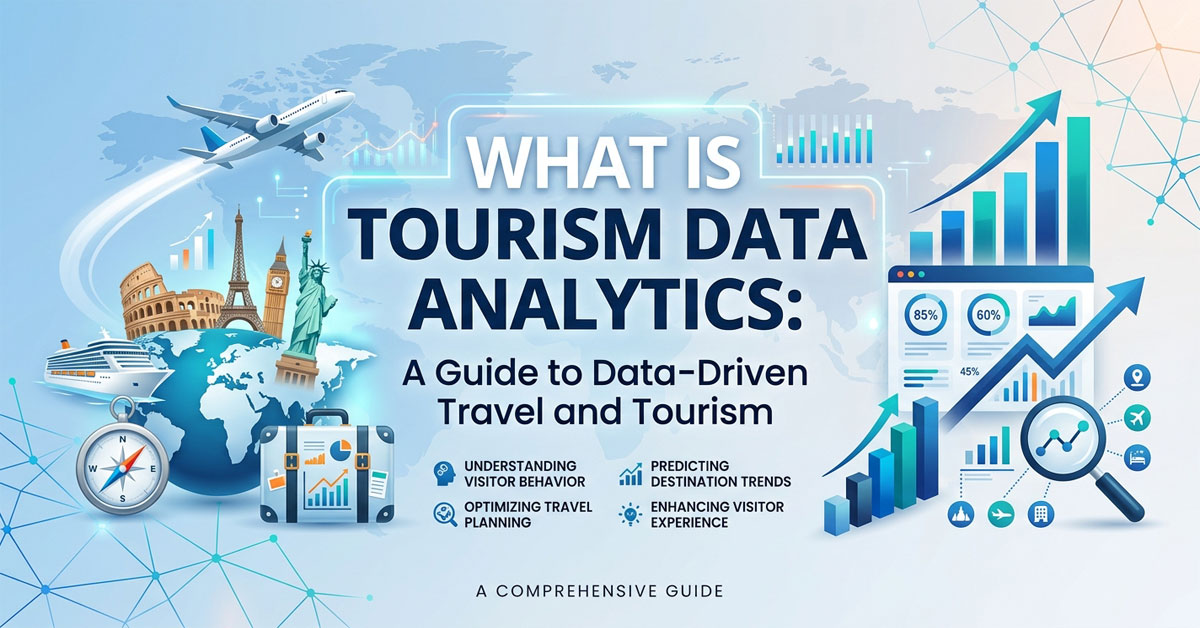
Tourism data analytics is the process of collecting, organizing, analyzing, and interpreting data related to travelers, destinations, tourism businesses, and visitor behavior so organizations can make smarter decisions. Put simply, it turns large amounts of tourism information into useful insights. A hotel might analyze booking patterns to predict how many rooms it will need next month, while a destination management organization might examine visitor arrivals, spending habits, transportation data, and online searches to understand what travelers actually want. Instead of relying entirely on intuition, tourism professionals can use evidence to decide where to invest money, how to price products, which markets to target, and how to improve the visitor experience. The idea is similar to having a detailed map before starting a long journey: the data does not necessarily make the decision for you, but it gives you a much clearer view of the road ahead.
Understanding Tourism Data Analytics
Tourism is an unusually data-rich industry because almost every stage of a traveler’s journey creates information. A person may search for flights, compare hotels, read reviews, reserve a room, purchase attraction tickets, use a digital map, post photographs, and leave a review after returning home. Each interaction can generate potentially valuable data. When these individual pieces are collected and analyzed responsibly, businesses and destinations can identify patterns that would be almost impossible to recognize by looking at isolated transactions. Tourism data analytics therefore goes beyond simply counting visitors. It asks deeper questions: Who is visiting? Why are they coming? When are they arriving? How much are they spending? What experiences do they prefer? What makes them return? What causes them to cancel?
The discipline combines ideas from statistics, business intelligence, economics, marketing, information technology, and increasingly artificial intelligence. Analysts may work with historical booking data, occupancy rates, average daily rates, visitor demographics, customer reviews, website traffic, social media activity, airline capacity, weather information, event calendars, and many other variables. The goal is not to collect every possible piece of information just because technology makes that possible. Good tourism analytics starts with a business or destination question and then determines which data can help answer it. That distinction matters because a huge database is not automatically useful. In fact, an organization drowning in irrelevant or poorly structured information can be less effective than a smaller organization with a focused, reliable dataset.
How Tourism Data Analytics Works
The tourism analytics process usually begins with data collection. Information can come from reservation systems, point-of-sale systems, customer relationship management platforms, government tourism statistics, surveys, websites, mobile applications, online travel agencies, review platforms, transportation providers, and other sources. Once collected, the information generally needs to be cleaned and standardized. Different systems may use different definitions, date formats, customer identifiers, or geographic classifications, so combining them without preparation can produce misleading results. Analysts then explore the data to identify trends, relationships, unusual changes, and recurring patterns.
The next stage is analysis. Depending on the question, analysts might use descriptive analytics to understand what happened, diagnostic analytics to investigate why it happened, predictive analytics to estimate what could happen next, or prescriptive analytics to explore which actions may produce better outcomes. Imagine a resort discovering that occupancy falls sharply every September. Descriptive analytics identifies the decline, diagnostic analysis examines potential causes such as seasonality or airline capacity, predictive analytics estimates future September demand, and prescriptive analysis can help management evaluate responses such as promotional campaigns, packages, events, or pricing adjustments. The process ultimately turns raw records into decisions.
Why Tourism Data Analytics Matters
Tourism businesses operate in an environment where demand can change rapidly. Seasonality, economic conditions, exchange rates, transportation availability, weather, geopolitical events, consumer confidence, major festivals, school holidays, and emerging travel trends can all influence visitor behavior. A business that waits until the end of the season to discover what happened has limited opportunity to respond. Analytics gives tourism organizations a way to monitor changing conditions and act earlier. It can reveal weak demand before a hotel experiences a major revenue problem or show growing interest in a destination before competitors fully recognize the opportunity.
There is also a financial reason analytics has become increasingly important. Tourism businesses have many resources that are difficult or impossible to store for later. An empty hotel room tonight cannot be sold tomorrow as tonight’s inventory. An airline seat that departs empty represents capacity that has disappeared. A restaurant table that remains unoccupied during a busy service period cannot be recovered later. Because tourism products are often time-sensitive, matching supply with demand is critical. Analytics helps organizations estimate demand, optimize prices, allocate staff, manage inventory, and design offers around actual customer behavior.
For destinations, the value extends beyond revenue. Tourism authorities can use data to understand visitor distribution, identify overcrowded areas, monitor the economic contribution of tourism, improve transportation planning, and develop strategies for more sustainable visitor flows. Instead of simply trying to maximize the number of arrivals, destination managers can ask whether tourism is creating desirable economic and social outcomes. That shift is important as destinations increasingly balance tourism growth with residents’ quality of life, environmental pressures, infrastructure capacity, and long-term sustainability.
The Role of Real-Time Tourism Data
Historical data remains valuable, but real-time and near-real-time information can provide an entirely different perspective. Consider a destination experiencing an unexpected surge in visitors because of a major sporting event or concert. Historical averages may not capture the immediate change in demand. Live information about accommodation searches, transportation activity, attraction capacity, traffic conditions, or digital engagement can help organizations respond while the event is still unfolding. This makes tourism analytics more dynamic than traditional annual tourism reports.
Real-time analytics can support operational decisions such as staffing, inventory management, pricing, transportation coordination, and visitor communications. A theme park, for example, could monitor crowd levels and adjust staffing or communicate wait times. A destination could identify congestion around a popular attraction and encourage visitors to explore alternative locations. A hotel might monitor booking velocity—the rate at which reservations are being made—to determine whether its current pricing strategy still makes sense.
However, speed should not be confused with accuracy. Real-time data can be noisy, incomplete, or affected by temporary events. A sudden increase in searches does not necessarily guarantee actual bookings. Similarly, social media activity may reflect attention rather than economic value. Strong tourism analytics therefore combines timely signals with context, historical patterns, and human judgment rather than treating every digital fluctuation as a definitive trend.
Types of Tourism Data
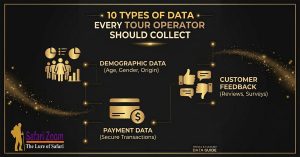
Tourism data can be divided into numerous categories because travelers interact with the industry in many different ways. Demand data includes bookings, arrivals, searches, cancellations, occupancy, and travel intent. Financial data can include revenue, spending per visitor, average transaction values, and profitability. Customer data may include demographics, preferences, loyalty behavior, feedback, and purchasing history. Operational data covers staffing, room availability, transportation capacity, attraction attendance, and resource utilization.
Geographic information is another important category. Location-based data can help organizations understand where visitors originate, which attractions they visit, how long they remain in specific areas, and how they move through a destination when appropriate and legally permitted. When aggregated and handled responsibly, this information can help cities and tourism authorities manage congestion and infrastructure. It can also reveal opportunities for developing attractions outside heavily visited zones.
Sentiment and behavioral data add another layer. Online reviews, survey responses, search queries, social media conversations, and customer-service interactions can provide clues about how visitors perceive an experience. A destination may discover that travelers love its scenery but repeatedly complain about transportation. A hotel might learn that guests appreciate its location but find check-in frustrating. Traditional statistics may show how many people visited, while sentiment data can help explain how those visitors felt about the experience.
Customer and Traveler Data
Traveler data is particularly valuable because tourism is fundamentally a customer-centered industry. Businesses want to understand not just the number of customers but the characteristics and behavior of different customer segments. For example, leisure travelers booking months ahead may behave very differently from business travelers making reservations shortly before arrival. Families, solo travelers, luxury customers, backpackers, and group travelers can have different spending patterns and expectations even when visiting the same destination.
Segmentation allows marketers and managers to move away from a one-size-fits-all approach. Instead of promoting exactly the same product to everyone, a tourism company can tailor messages and packages to relevant audiences. Analytics can identify which customer groups generate strong revenue, which channels produce high-value bookings, and which offers encourage repeat purchases. This can make marketing more efficient because organizations can focus resources where they are most likely to produce meaningful results.
Customer data must, however, be treated carefully. Personal information should not be collected or used simply because it is technically accessible. Tourism organizations need appropriate privacy practices, security controls, transparency, and compliance with applicable laws. The best analytics strategy is not the one that knows everything about every traveler; it is the one that obtains appropriate information, protects it, and uses it for legitimate purposes.
In order to achieve this and take your tourism marketing beyond intuition. Learn online how Excel, SQL, Python and Tableau can be used to analyze customer behavior and make smarter marketing decisions.
Destination and Operational Data
Destination data looks beyond individual customers and examines the tourism ecosystem as a whole. Government agencies, tourism boards, hotels, airports, attractions, transportation companies, restaurants, and other organizations can all contribute pieces of the larger picture. Visitor arrivals, length of stay, accommodation occupancy, visitor spending, transportation capacity, attraction attendance, and event schedules can help create a more complete understanding of tourism activity.
Operational data is equally important at the business level. A hotel can analyze room demand, housekeeping schedules, cancellations, maintenance requirements, and staff productivity. An attraction can examine ticket sales, entrance times, capacity utilization, and visitor flow. A restaurant in a tourism district can study reservations, average spending, peak periods, and customer reviews. These insights can improve efficiency while also supporting a smoother visitor experience.
The real value often appears when datasets are combined. Suppose a destination knows that international arrivals are increasing but average length of stay is falling. That could lead to very different strategic questions than simply observing rising arrival numbers. Perhaps travelers are using the destination as a short stopover, or perhaps accommodation costs are pushing them toward shorter visits. Combining tourism statistics with pricing, transportation, and customer behavior can help decision-makers investigate the underlying story.
Key Sources of Tourism Data
Tourism organizations have access to more data sources than ever before. Traditional sources include national statistical offices, tourism ministries, airport authorities, accommodation surveys, visitor surveys, and economic reports. These sources are valuable because they often provide structured, standardized information over long periods, making them useful for measuring broad trends.
Commercial systems provide another major source. Hotels generate reservation and occupancy records, airlines collect booking and capacity information, attractions record ticket sales, and travel agencies manage customer transactions. Online travel platforms can provide information about searches, bookings, cancellations, reviews, and pricing, subject to the platform’s access rules and applicable agreements.
Online and Digital Data Sources
Digital channels have transformed tourism research. Search engines can reveal what destinations travelers are researching, while websites can show which pages attract attention and where users leave a booking journey. Social networks can provide signals about emerging interests, although those signals must be interpreted carefully because online popularity does not always translate into actual travel demand.
Reviews are especially useful for experience analysis. Thousands of individual comments can be processed using text analytics and sentiment analysis to identify recurring themes. Instead of manually reading every review, an organization can analyze whether complaints are concentrated around cleanliness, service, transportation, pricing, food, noise, or other factors. Analysts can then compare those themes across properties, seasons, customer segments, or destinations.
Other digital sources may include mobility information, connected devices, weather feeds, event calendars, and transportation data. These sources can provide context that conventional tourism statistics often lack. The challenge is making sure the information is representative, accurate, legally obtained, and interpreted within the right context.
How Tourism Businesses Use Analytics
Tourism businesses use analytics across marketing, revenue management, operations, customer experience, and strategic planning. A hotel may forecast occupancy and adjust room prices according to expected demand. An airline can analyze booking curves to understand when customers typically purchase tickets. A tour operator can examine which excursions sell best among different visitor segments. A destination marketing organization can measure whether advertising campaigns actually generate meaningful interest and bookings rather than simply impressions.
Analytics also supports experimentation. A tourism company can compare two marketing messages, pricing strategies, website designs, or packages and measure which performs better. Over time, these small experiments can produce substantial improvements. The important point is that analytics should not be viewed as a giant report produced once a year. It works best as an ongoing feedback loop: make a decision, measure the outcome, learn from the result, and improve the next decision.
Hotels and Accommodation
Hotels are among the clearest examples of tourism analytics in practice. Revenue managers constantly evaluate occupancy, booking pace, historical demand, room types, cancellation behavior, competitor pricing, events, and seasonal patterns. Their objective is not simply to sell every room as quickly as possible. They need to determine the right combination of price, timing, availability, and customer segment to maximize performance.
Analytics can also improve hotel operations. Forecasting expected arrivals and departures helps managers plan housekeeping and front-desk staffing. Customer feedback can reveal recurring service issues. Guest purchasing patterns can help hotels determine which amenities, packages, or food-and-beverage offerings are worth promoting. Even maintenance can become more data-driven when organizations monitor equipment performance and identify problems before failures affect guests.
The same principle applies to short-term rentals, resorts, hostels, and other accommodation providers. The specific metrics may differ, but the fundamental question remains the same: what does the available evidence tell us about demand, customer expectations, costs, and performance?
Benefits of Tourism Data Analytics
One of the biggest advantages of tourism analytics is better decision-making. Managers no longer have to rely entirely on instinct or anecdotal feedback. Data can test assumptions and reveal patterns that may contradict conventional wisdom. That does not make human experience irrelevant; instead, it gives experience a stronger foundation.
Analytics can also improve personalization. When organizations understand customer preferences and behavior, they can create more relevant recommendations and offers. A traveler interested in cultural experiences should not necessarily receive the same promotional content as someone primarily interested in adventure activities. Relevant personalization can improve engagement while reducing wasted marketing spend.
Another major benefit is operational efficiency. Tourism organizations can identify periods of high demand, allocate employees accordingly, reduce unnecessary inventory, and anticipate bottlenecks. Better forecasting can also help reduce waste. Restaurants, for example, can use historical demand patterns to improve purchasing and preparation, while attractions can align staffing with expected attendance.
Better Forecasting and Decision-Making
Forecasting is one of the most powerful applications of tourism data analytics. Historical patterns can establish a baseline, while current signals help modify expectations. A destination might combine previous seasonal demand with airline schedules, hotel searches, economic indicators, events, and weather forecasts to estimate future visitor volumes. No forecast is perfect, but even an imperfect forecast can be much more useful than having no structured expectation at all.
Predictive analytics becomes particularly valuable when decisions have to be made before demand is visible. Hotels need to set prices before guests arrive. Airlines need to plan capacity well in advance. Destination marketers may need to commit campaign budgets months before a travel season. Forecasting gives these organizations a way to think probabilistically about what may happen rather than treating the future as a complete mystery.
The best forecasting systems also learn from their mistakes. If a model consistently overestimates demand for a particular segment, analysts can investigate why and adjust the model. This creates a continuous improvement process. Tourism analytics therefore resembles navigation with a constantly updating GPS: historical information establishes the route, current information shows changing conditions, and new observations help improve future decisions.
Challenges of Tourism Data Analytics
Tourism analytics has enormous potential, but it is not a magic solution. One major challenge is data quality. If the underlying information is incomplete, outdated, duplicated, biased, or incorrectly categorized, sophisticated analysis can produce confidently wrong conclusions. The old principle of “garbage in, garbage out” applies strongly here.
Data integration is another obstacle. A hotel may have reservation information in one platform, customer feedback in another, marketing data somewhere else, and financial information in a separate accounting system. Connecting these systems can be technically difficult. Different organizations within a destination may also define metrics differently, making comparisons harder than they initially appear.
Privacy, Quality, and Data Integration
Privacy deserves particular attention because tourism data can involve sensitive personal information. Organizations need clear rules about what they collect, why they collect it, how long they retain it, who can access it, and how it is protected. Depending on where an organization operates and where its customers are located, various privacy and data-protection requirements may apply. Responsible analytics should therefore include privacy and security from the beginning rather than treating them as an afterthought.
Bias is another concern. Digital data does not always represent the entire traveler population equally. Some groups may use certain platforms more heavily than others, while some travelers may rarely leave digital traces. If an organization analyzes only online behavior, it could accidentally develop a distorted view of its customers. Combining multiple sources and understanding their limitations can reduce this risk.
Finally, organizations need skilled people. Buying an analytics platform does not automatically create an analytics culture. Teams need to know how to formulate useful questions, interpret statistical results, communicate uncertainty, and turn findings into action. Otherwise, dashboards can become attractive screens that nobody uses effectively.
The Future of Tourism Data Analytics
The future of tourism analytics is increasingly connected to artificial intelligence, machine learning, automation, and real-time decision systems. AI can process large volumes of structured and unstructured information much faster than traditional manual approaches. It can help identify patterns in reviews, forecast demand, segment customers, detect anomalies, and generate recommendations. Generative AI can also make analytical insights easier for nontechnical employees to explore through natural-language interfaces.
Artificial Intelligence and Predictive Analytics
AI-powered tourism systems could allow managers to ask questions in ordinary language, such as, “Which customer segments are most likely to book this package next month?” or “Why did cancellations increase during this period?” The system could then examine connected datasets and present relevant evidence. That could make analytics accessible to employees who are not trained data scientists.
Predictive systems will also become more sophisticated as organizations combine more contextual information. Instead of forecasting hotel demand solely from historical occupancy, models can potentially consider booking behavior, transportation capacity, events, weather, economic conditions, search behavior, and other relevant signals. The challenge will be ensuring that increased complexity actually improves decisions rather than simply making models harder to understand.
Sustainability is likely to become another major area of tourism analytics. Destinations can use data to monitor visitor pressure, transportation patterns, resource consumption, and the distribution of tourism activity. The goal can shift from asking, “How do we attract more people?” to a more nuanced question: “How do we create better tourism outcomes for visitors, businesses, residents, and the environment?”
Final word
Tourism data analytics is essentially the practice of turning tourism-related information into actionable knowledge. It helps hotels, airlines, travel companies, attractions, governments, and destinations understand demand, improve operations, personalize experiences, forecast future conditions, and make more informed strategic decisions. From booking records and customer reviews to transportation statistics and real-time digital signals, modern tourism generates an enormous amount of information. The organizations that can responsibly turn that information into useful insight have an opportunity to respond more intelligently to a rapidly changing travel market.
The important thing to remember is that analytics is not simply about collecting more data. It is about asking better questions and connecting reliable evidence to meaningful decisions. A sophisticated dashboard cannot compensate for poor data, unclear objectives, weak privacy practices, or a team that does not know how to interpret results. Used thoughtfully, though, tourism data analytics can act like a compass for the industry—helping organizations understand where travelers are coming from, what they value, where problems are emerging, and what opportunities may lie ahead. As artificial intelligence and predictive technologies continue to develop, the role of data in tourism is likely to become even more central.
To wind out, tourism analytics combines statistics, business intelligence, marketing, information technology and increasingly artificial intelligence. If you want to develop practical skills, consider starting with Excel and progressing to SQL, Python and business intelligence tools.
Recommended Learning Path
Master data analytics step-by-step
Excel for Data Analysis
SQL for Data Analysis
Python for Data Analysis
Power BI
Tableau
AI for Data Analytics