Running a successful tour operation involves much more than creating attractive itineraries and waiting for travelers to book. Behind every memorable excursion is a stream of information: who your customers are, what they want, how they found you, what they purchased, what they enjoyed, and where your business is losing money. When that information is collected consistently and used intelligently, it becomes one of the most valuable assets a tour operator can have. Tour operator data can help you understand your guests almost like a good local guide understands a destination—quietly, contextually, and with a sense of what comes next.
The challenge is knowing what information actually matters. Collecting everything simply because your booking software allows it can create clutter rather than clarity. A better approach is to focus on data that answers practical business questions. Which tours are most profitable? Which customers are likely to return? Why are people abandoning bookings? Which marketing channel brings travelers who actually spend money? Which destinations are becoming more popular? Those are the questions that useful data can answer.
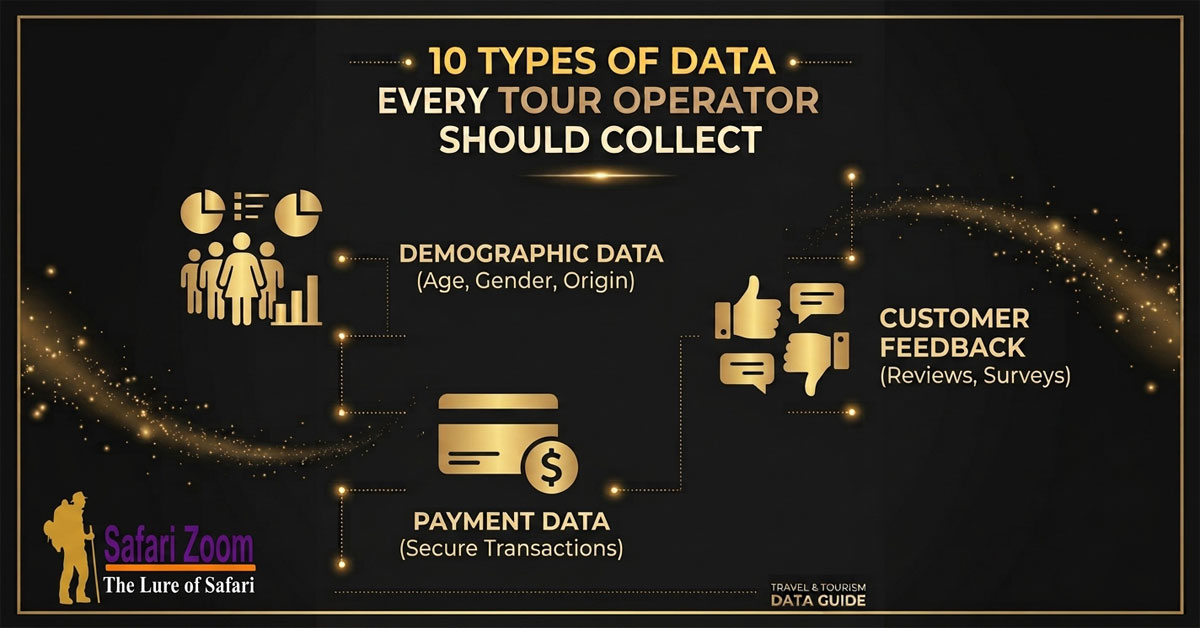
For tour operators, the most valuable information generally falls into ten broad categories: customer profiles, booking history, preferences, marketing sources, revenue, feedback, operations, digital behavior, communication engagement, and market trends. Each category provides a different piece of the puzzle. Put them together, and you can make smarter decisions about marketing, pricing, staffing, product development, customer service, and growth.
Why Data Collection Matters for Modern Tour Operators
Tourism is an experience-driven industry, which means customer expectations can change quickly. Travelers increasingly compare destinations, activities, prices, reviews, and operators before making a decision. A tour company that understands these behaviors has a significant advantage over one that relies entirely on instinct. Experience still matters, of course, but good data gives that experience a sharper edge.
Imagine running your business without knowing which tours generate the most repeat bookings. You might promote your most popular excursion because it sells frequently, even though another tour produces substantially higher margins. Or perhaps you spend heavily on social media because it generates lots of website traffic, while search engines produce fewer visitors but twice as many paying customers. Without data, these differences can remain hidden.
Good tour operator analytics turns vague assumptions into measurable patterns. Instead of saying, “Families seem to like this tour,” you can examine booking records and discover that travelers with children between certain ages consistently choose shorter excursions with flexible meal options. Instead of guessing when demand will rise, you can examine historical bookings, geographic markets, and seasonal patterns.
Data also helps operators create more personalized experiences. A returning traveler should not always feel like a stranger walking through the same booking funnel as everyone else. Knowing that someone previously booked a food tour, enjoyed a private guide, or prefers morning departures can help you make more relevant recommendations.
How Better Data Improves the Guest Experience
The best use of data is not simply extracting more revenue from customers. It is creating a smoother journey from discovery to departure and beyond. When information is organized properly, travelers can receive recommendations that make sense rather than generic promotions that feel like digital noise.
For example, if a guest previously booked an adventure tour, you might recommend another activity with a similar difficulty level rather than sending an unrelated luxury package. If a customer consistently travels during a particular month, a timely reminder about upcoming availability may be more useful than a random newsletter. Personalization works because it reflects context.
Data can also identify friction. A high cancellation rate could indicate unclear tour descriptions, inconvenient pickup arrangements, unrealistic expectations, or pricing problems. Repeated customer complaints about meeting points may reveal an operational issue that management never noticed.
That is why customer data for tour operators should be viewed as a feedback system. Every booking, interaction, review, cancellation, and inquiry provides information about how your business performs. The goal is not to collect data for its own sake. The goal is to listen to what that data is telling you for decision making. Now, let’s view important data types we should collect.
1. Customer and Traveler Profile Data
The foundation of useful tour operator data is a clear understanding of your customers. This does not mean collecting every personal detail imaginable. It means recording relevant information that helps you serve travelers, understand your market, and make sensible business decisions.
Basic profile information can include a customer’s name, age range, country or region, preferred language, household or travel-party characteristics, and contact details where appropriate. Depending on the type of tour you operate, other useful information may include accessibility requirements, dietary considerations, or broad travel preferences. Sensitive information should only be collected when there is a legitimate operational reason and should be handled carefully.
The real value appears when these profiles are connected to purchasing behavior. Knowing that a customer lives in Germany tells you something. Knowing that German travelers aged 35–54 from your database frequently book seven-day cultural tours in September tells you much more. The difference is context.
What Customer Profile Information to Record
A useful customer profile might contain:
The important word here is relevant. More data is not automatically better data. If a field does not help you improve service, comply with an operational requirement, understand demand, or make a legitimate business decision, ask whether you need it at all.
Customer profiles become particularly valuable for segmentation. You might discover that solo travelers behave very differently from families, while honeymoon travelers may have completely different expectations from budget-conscious backpackers. Instead of treating everyone as one giant audience, you can develop targeted products and campaigns.
A mature customer database can therefore become the equivalent of a detailed map. It shows where your guests come from, what they tend to buy, and how their relationship with your company develops over time.
2. Booking and Reservation Data
If customer profiles tell you who your travelers are, booking data tells you what they actually do. Customer preferences tell you what travelers say they want. Booking data shows what they actually choose, when they book, how much they spend, and which experiences they return for. This makes reservation information one of the most important categories of data a tour operator can collect.
Booking records should ideally capture the tour purchased, booking date, travel date, number of participants, booking value, booking status, cancellation information, selected options, pickup location, and other operational details relevant to the experience. Over time, this creates a historical record of demand.
The distinction between booking date and travel date is particularly useful. A customer may reserve a tour three months before departure during peak season but only a few days in advance during another period. Understanding this booking window helps operators forecast demand and determine when marketing messages should be intensified.
How Booking History Reveals Customer Behavior
Imagine discovering that your most popular city tour receives 40% of its bookings within five days of departure. That insight could change your marketing strategy. Instead of spending the same amount throughout the year, you could increase promotional activity shortly before likely booking periods.
Booking data also helps identify repeat customers. A traveler who has purchased three experiences from you over two years is fundamentally different from someone making a first purchase. Their behavior can inform loyalty programs, cross-selling, personalized offers, and retention campaigns.
Cancellations are another gold mine of information. A cancellation is not merely a lost transaction. It may reveal a pricing issue, scheduling problem, weather sensitivity, communication failure, or mismatch between customer expectations and the product description.
Look at booking patterns across products, dates, customer groups, and markets. Which tours sell out first? Which consistently underperform? How far ahead do customers book? Which products are frequently purchased together? Which tours have unusually high cancellation rates?
These questions transform raw reservation records into actionable tourism data. The booking system should not be treated merely as a digital calendar. Properly organized, it becomes one of your clearest windows into customer demand.
3. Tour and Activity Preference Data
Two customers can visit the same destination and want completely different experiences. One may want a relaxed food tour with plenty of conversation, while another wants hiking, adrenaline, and as little downtime as possible. Collecting information about preferences helps operators understand these differences.
Preference data may cover activity type, duration, group size, physical intensity, food interests, cultural interests, accommodation preferences, transportation preferences, private versus shared experiences, and other product attributes. Some preferences can be inferred from purchases, while others can be collected directly through booking forms, surveys, or customer conversations.
The trick is to distinguish between stated preferences and observed preferences. A traveler might say they enjoy adventure activities but repeatedly purchase cultural experiences. Both pieces of information matter, and the contradiction itself can be interesting.
Turning Preferences Into Personalized Experiences
Preference data can make recommendations much more useful. A customer who repeatedly chooses small-group excursions might appreciate being informed about a new premium small-group itinerary. Someone who consistently chooses private tours may be less interested in a discounted shared excursion.
This information can also improve product development. Suppose hundreds of customers choose tours lasting four to six hours, while your newly launched eight-hour excursion receives poor demand. The problem may not be marketing alone. Your customers may simply prefer shorter experiences.
Preferences can also uncover opportunities for bundles. Travelers who book a walking tour might frequently purchase a food experience on the following day. That relationship could inspire a package that makes both experiences easier to discover.
Over time, tour preference data helps you move from selling fixed products to designing experiences around real demand. You are no longer asking, “What tour should we create?” in isolation. You are asking, “What experience are our customers repeatedly showing us they want?”
That subtle change can save money and reduce the risk of launching products based solely on intuition.
4. Marketing and Lead Source Data
Every tour operator wants more bookings, but not every source of traffic deserves equal investment. Marketing data helps you determine where customers originate and which channels actually contribute to revenue.
Track relevant acquisition sources such as organic search, paid advertising, social media, email campaigns, referral partners, travel agencies, online travel marketplaces, direct traffic, and other identifiable sources. Ideally, connect those sources to actual bookings rather than stopping at clicks or impressions.
A social campaign that attracts 50,000 visitors may look impressive. But if those visitors rarely book, its business value may be lower than a small search campaign that attracts 2,000 highly motivated travelers and generates substantial revenue.
Measuring Which Marketing Channels Actually Work
This is where tour operator marketing analytics becomes powerful. Instead of asking which channel receives the most attention, ask which channel delivers profitable customers.
Useful metrics include:
A channel that generates cheap bookings may not necessarily be the best channel if its customers cancel frequently or rarely purchase again. Likewise, a channel with a higher acquisition cost may be more valuable if it attracts travelers who spend more and return.
Tracking source data also helps you understand your audience’s discovery journey. Someone might first encounter your brand through a travel video, visit your website weeks later through Google, and finally book after receiving an email. Customer journeys are rarely as linear as a simple “clicked ad, purchased immediately” model suggests.
The more accurately you can connect marketing touchpoints to bookings, the easier it becomes to allocate your budget intelligently.
5. Revenue and Payment Data
Revenue data tells you how much money comes into the business, but good financial analysis goes beyond total sales. Tour operators should examine booking value, discounts, refunds, commissions, payment fees, product-level revenue, and—where possible—profitability.
A tour selling 1,000 seats at a low price may generate less profit than a premium experience selling a fraction of that volume. Looking only at revenue can therefore produce misleading conclusions.
Track the financial performance of individual products, dates, customer segments, channels, and distribution partners. This allows you to identify where your business makes money and where it merely creates activity.
Using Financial Data to Improve Profitability
Suppose your most heavily booked excursion requires expensive transportation, several guides, and high operational overhead. Meanwhile, a less popular walking experience has excellent margins and consistently positive reviews. The answer is not necessarily to abandon the popular tour. Instead, the financial data gives you the information needed to price, package, schedule, or redesign it more effectively.
Discounting deserves particular attention. Frequent discounts can make gross sales appear healthy while quietly eroding profitability. Compare discounted bookings with full-price bookings and examine whether promotions actually create incremental demand or simply reduce the price paid by people who would have purchased anyway.
Payment data can also highlight operational problems. High refund rates, failed payments, or chargebacks may indicate weaknesses in your checkout experience or customer communication.
The objective is to understand revenue quality, not just revenue quantity. A data-driven tour operator asks, “What did we sell, to whom, through which channel, at what cost, and with what final margin?” Those questions reveal the economic engine underneath the booking numbers.
6. Customer Feedback and Satisfaction Data
A customer review is more than a public rating. It is a direct account of what a traveler experienced, expected, appreciated, disliked, or misunderstood. That makes feedback one of the richest sources of qualitative data available to a tour operator.
Collect ratings, written reviews, post-tour surveys, complaints, compliments, support conversations, and recurring suggestions. Look beyond average scores. Two tours could both have a 4.7-star rating while receiving very different types of feedback.
One might be praised for guides and criticized for transportation. Another might receive enthusiastic comments about scenery but repeated complaints about unclear meeting instructions. The average rating alone does not reveal those patterns.
Finding Patterns in Reviews and Complaints
Read feedback at scale and categorize recurring themes. Are customers mentioning guides, food, safety, punctuality, itinerary accuracy, communication, comfort, value, or meeting points?
You can also compare feedback by product, guide, season, customer segment, and location. If complaints about long waits increase during a particular month, perhaps the issue is seasonal congestion rather than poor staff performance.
Positive feedback is equally valuable. Customers often tell you exactly what differentiates your product when they write reviews. Phrases such as “our guide made the experience feel personal” or “the small group made all the difference” can reveal selling points that deserve greater emphasis in marketing.
Feedback data closes the loop between promise and reality. Your website tells customers what you intend to deliver; reviews tell you what they actually experienced. The gap between those two perspectives is where some of the best improvement opportunities live.
7. Operational and Tour Performance Data
Great marketing cannot compensate for poor operations. Tour operators therefore need data about what happens behind the scenes.
Operational information can include tour capacity, actual attendance, guide assignments, departure times, delays, vehicle utilization, cancellations, no-shows, weather disruptions, incidents, supplier performance, and itinerary duration. Depending on the business, you may also track equipment usage and maintenance.
This information helps identify bottlenecks before they become customer complaints. If a particular pickup location regularly causes delays, operational records can expose the pattern. If a guide consistently receives excellent feedback while maintaining strong punctuality, that information can help with scheduling and training.
Tracking Capacity and Guide Performance
Capacity management is especially important. A tour that sells out frequently may present an opportunity to add departures, increase capacity where practical, or introduce a premium alternative. A tour that regularly operates with very few participants may require schedule changes, product repositioning, or a different pricing strategy.
Cancellations should also be analyzed by cause. Weather-related cancellations require a different response from cancellations caused by confusing booking policies.
Guide performance data should be handled fairly and contextually. Numbers should support coaching and operational decisions rather than becoming a simplistic scorecard. A guide leading difficult adventure trips may naturally receive different feedback than one leading relaxed sightseeing tours.
When operational data is connected with customer and financial data, the picture becomes much clearer. You can see not only what sold, but whether you delivered it efficiently and profitably.
8. Website and Digital Behavior Data
Before travelers book a tour, they often spend time researching. Website analytics can show what they look at, where they hesitate, and which pages lead toward conversion.
Useful digital behavior information can include landing pages, popular tour pages, search queries, traffic sources, device categories, booking funnel behavior, and conversion events. With appropriate privacy controls and consent practices, this data can help identify friction in the customer journey.
Suppose thousands of visitors view a tour page but very few begin the booking process. That does not automatically mean the tour is unattractive. Perhaps the price is unclear, the call-to-action is difficult to find, availability information is missing, or customers need answers to common questions before committing.
Understanding What Travelers Do Before Booking
Website behavior should be interpreted as a journey rather than a collection of isolated numbers. A traveler might read an itinerary, check the FAQ, view cancellation terms, return two days later, and then book. That sequence tells a much richer story than a single pageview.
Search behavior is also valuable. If visitors repeatedly search your site for “private airport transfer,” but you do not offer it, that could represent an opportunity. If travelers repeatedly search for information about accessibility, you may need to make existing accessibility information easier to find.
Digital data can therefore reveal both customer intent and website friction. Used properly, it can help you simplify navigation, improve product pages, answer objections, and make the path to booking easier.
9. Customer Communication and Engagement Data
Tour operators often communicate with customers through email, SMS, messaging platforms, and other channels before and after a trip. Engagement data can help determine which communications are useful and which are being ignored.
Track relevant information such as message delivery, opens where reliable and appropriate, clicks, replies, bookings generated from campaigns, and unsubscribe behavior. More importantly, connect communications to the customer’s stage in the journey.
A pre-tour message should accomplish something different from a post-tour message. Before departure, customers need practical information such as meeting instructions, timing, what to bring, and expectations. After the tour, they may be receptive to feedback requests, recommendations, referrals, or future-trip ideas.
Building More Relevant Follow-Up Campaigns
Segmentation makes communication significantly more effective. A first-time visitor does not necessarily need the same message as a loyal repeat customer. Likewise, someone who abandoned a booking may need reassurance or clarification rather than another generic promotional email.
Engagement data can show which messages drive action. If reminders sent 24 hours before departure consistently reduce confusion and support requests, that communication has measurable operational value.
Be careful not to confuse activity with effectiveness. A large email list is not automatically an asset if subscribers are disengaged. A smaller database containing customers who genuinely want relevant travel information can be far more valuable.
The goal of communication data is simple: send the right information to the right traveler at the right moment. When that happens, marketing becomes less like shouting into a crowd and more like having a useful conversation.
10. Seasonal, Geographic, and Market Trend Data
Tourism demand rarely stays constant. Seasons, school holidays, weather, destination popularity, economic conditions, events, flight availability, and traveler preferences can all influence bookings.
Collect historical booking patterns by month, destination, customer origin, product, travel date, and booking window. Over time, these records can help reveal recurring cycles and emerging trends.
Using Trends to Forecast Demand
Geographic data can be particularly useful. Perhaps travelers from one country tend to visit during spring, while another market peaks in autumn. That insight can influence advertising schedules, website localization, partnerships, staffing, and inventory planning.
Seasonality also affects pricing and capacity. If demand consistently spikes during particular weeks, operators can prepare staffing and suppliers well in advance. Conversely, low-demand periods might be opportunities for special packages, local campaigns, or new products.
Historical data should not be treated as a crystal ball. Conditions change, and the past does not guarantee the future. But historical patterns give operators a baseline for planning.
Combining internal records with broader market signals can make forecasts stronger. Search interest, destination trends, competitor activity, flight capacity, and major events may provide additional context. The objective is not perfect prediction. It is making better-informed decisions before demand arrives.
How to Organize Tour Operator Data in One System
Collecting ten categories of information as seen above is useful only if the information can be accessed and connected. Scattered spreadsheets, inboxes, booking platforms, accounting systems, and social media dashboards can create isolated pockets of knowledge.
A centralized tour operator CRM or data system can bring customer profiles, reservations, communication history, preferences, and other relevant records together. Integration with booking, payment, accounting, marketing, and website systems can reduce manual data entry and improve consistency.
Start with the questions your business needs to answer. Do not begin by buying the most complicated software available. Determine which reports would genuinely influence decisions, then work backward to identify the data required to produce them.
Clean data matters just as much as collected data. Duplicate customers, inconsistent country names, missing booking values, outdated contact details, and conflicting records can undermine analysis. Establish clear definitions for important fields and review data quality regularly.
The ideal system should make information easier to use, not create another administrative burden. If employees need ten clicks to find a basic customer record, the system will eventually be ignored.
Data Privacy, Security, and Responsible Collection
Customer information comes with responsibility. Tour operators may handle names, contact information, payment-related information, travel details, preferences, and sometimes sensitive requirements. Collecting and storing such information should therefore follow applicable privacy and data-protection laws.
The principle of data minimization is useful: collect what you legitimately need, explain why you need it, protect it appropriately, and avoid retaining information indefinitely without a reason.
Access controls should ensure employees only see information relevant to their responsibilities. Payment information should be handled through appropriate secure payment providers rather than casually stored in spreadsheets or internal documents.
Customers should also receive clear information about how their data is used, particularly for marketing and personalization. Consent requirements vary by jurisdiction and communication type, so operators should obtain appropriate legal guidance for their markets.
Trust is especially important in tourism. Travelers are placing their time, money, and personal information in your hands. Responsible data management is therefore not just a compliance exercise—it is part of delivering a professional customer experience.
How to Turn Collected Data into Better Business Decisions
Data becomes valuable when it changes what you do. A dashboard full of colorful charts is not necessarily useful if nobody acts on the information.
Create a small set of key performance indicators connected to actual business goals. These might include booking conversion rate, average booking value, repeat customer rate, cancellation rate, occupancy, customer acquisition cost, revenue per tour, and customer satisfaction.
Review the numbers regularly and compare them over time. A single week’s result can be noisy, while six or twelve months may reveal a meaningful pattern.
It also helps to combine quantitative and qualitative information. A drop in bookings is a number. Customer interviews explaining that travelers perceive your cancellation policy as restrictive provide context. Both matter.
The strongest operators create a feedback loop: collect data → analyze patterns → make a change → measure the result → refine the strategy. That process turns data from a static archive into an active management tool.
Common Data Collection Mistakes Tour Operators Should Avoid
One common mistake is collecting too much information. Long booking forms can frustrate customers and increase abandonment. Every field should earn its place by providing meaningful operational, customer-service, marketing, or analytical value.
Another mistake is keeping data in disconnected systems. When marketing knows one version of a customer, operations knows another, and finance has a third, inconsistencies become inevitable.
Operators also sometimes focus too heavily on vanity metrics. Website traffic, social followers, and email opens may be interesting, but they do not necessarily translate into profitable bookings.
Poor data quality is another serious issue. If staff enter information inconsistently, reports become unreliable. A simple data-entry standard can prevent many problems.
Finally, avoid collecting information without a clear purpose. Responsible data strategy is not about building the biggest database possible. It is about building a trustworthy information system that helps the business make better decisions while respecting travelers.
A Practical Data Collection Strategy for Tour Operators
The easiest way to begin is to prioritize. Start with the information closest to revenue and customer experience: customer profiles, bookings, product preferences, acquisition sources, financial performance, and feedback. Once those foundations are reliable, expand into operational and digital behavior analysis.
Create consistent definitions. Decide what counts as a booking, cancellation, repeat customer, lead, refund, or qualified inquiry. Without shared definitions, two employees can look at the same business and produce completely different reports.
Automate routine collection wherever possible. Booking systems can capture reservation details, analytics platforms can record website behavior, payment systems can record transactions, and CRM tools can organize customer interactions. Automation reduces manual work and improves consistency.
Then establish a regular review rhythm. Weekly reviews can focus on operational issues and near-term bookings, while monthly reviews can examine marketing and financial performance. Quarterly reviews can explore customer segments, product development, and broader market trends.
Most importantly, keep the strategy practical. You do not need a giant analytics department to become more data-driven. You need accurate information, clear questions, sensible tools, and a habit of acting on what the numbers reveal.
Conclusion
The most successful tour operators do not treat data as a pile of numbers sitting inside a booking system. They treat it as a conversation with the business. Customer profiles explain who travelers are, booking data shows what they purchase, preference data reveals what they want, and marketing data explains how they found you. Revenue and operational information show whether the business can deliver those experiences profitably, while reviews and communication data reveal how customers perceive the journey.
The ten categories work best when connected. A booking is not just a transaction; it can tell you about a customer’s preferences, acquisition source, spending behavior, travel timing, and future potential. A cancellation is not merely lost revenue; it can reveal friction in your product or booking process. A positive review is not just social proof; it can expose the precise feature that makes your experience memorable.
Start small, keep your information accurate, respect customer privacy, and focus on questions that matter. When data collection becomes part of everyday decision-making, tour operators can stop guessing and start responding to real traveler behavior. And in an industry where expectations, destinations, and demand can change quickly, that ability to listen—and act—is a serious competitive advantage.